#219) ASPEN ENVIRONMENT FORUM: Storytelling at Work
June 27th, 2012
I’m kinda tired of lecturing about the power of storytelling. But just as I was starting to doubt myself I watched two very skilled storytellers ply their trade at the Aspen Environment Forum. Which just made me sit back and think, THAT is what I’ve been talking about. When it works, it’s so powerful. 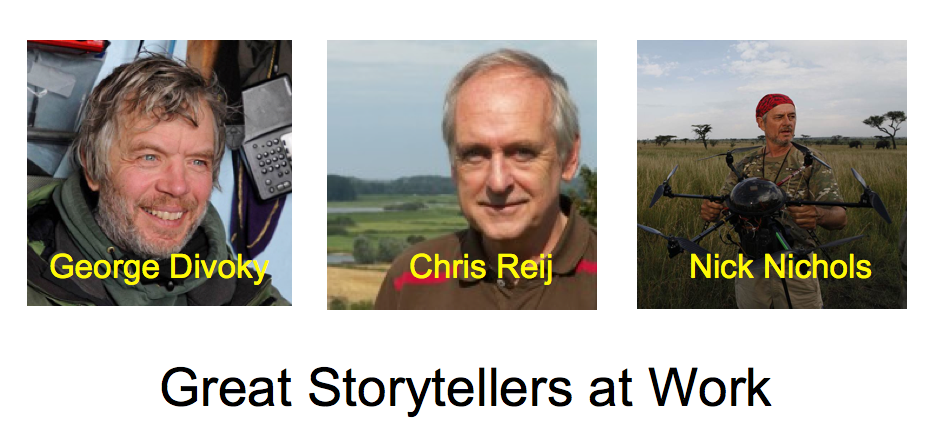
THREE GREAT STORYTELLERS AT WORK. George Divoky who for nearly three decades has been studying the birds of Cooper Island which is waaaay up at the top of Alaska, Chris Reij who has done a lot of work in Africa and told amazing stories of some kinda water pits or something in Niger — I don’t know, I only know he told the amazing story of having sat next to the assistant to the President of Niger’s wife, and ended up ghostwriting the President’s speech. Amazing stories from both. Unfortunately I missed the third speaker, National Geographic photographer Nick Nichols, who gave an evening talk I couldn’t attend that was a sort of career-encapsulating presentation in which he showed some of his best photos over the years and told stories that were apparently packed with humor and emotion. People the next morning were raving about it, and I felt like a dummy having missed a presentation that exemplified the very principles I espouse.
mouse spouse
THE ASPEN ENVIRONMENT FORUM
I spent the weekend at the Aspen Environment Forum. Lotsa talks. Lotsa “networking”. Some doses of the same stuff that made Juliette Eilperin of the Washington Post say rather sad things about the Rio + 20 Summit last week (yay for her honesty!). But overall an amazingly powerful event where I met at least 5 characters that were a real treat to speak with. Make that 6. Or 7. Whatever. The experience that had the biggest impact on me was listening to two very effective storytellers who solidified my convictions about the power of telling good stories.
dice
A VISUAL PUNCH LINE IN THE THAWING ARCTIC
The first amazing storyteller was George Divoky. I met him in January at the Alaska Marine Science Symposium in Anchorage. At the time my brain was largely shut down from temperature shock — it was literally minus 20 the first evening and I walked about five blocks from a restaurant to the hotel and thought I was going to die from hypothermia. He introduced himself shortly after that, saying we were both going to speak at the Aspen event. I kinda said “yeah, whatever, I may not survive this place.”
So as he started his talk this past Saturday I began to realize, “oh, this is that guy,” then I heard a truly great story.
It was relatively simple. 27 years of visiting the same island at the top of Alaska, just off of Barrow. 27 years of following seabirds called guillemots that make their nests in a bunch of wooden boxes left behind by the navy. Twenty seven years of spending summers alone walking about the island counting birds and telling stories to himself. Then a twist in the story… Suddenly no ice.
Starting about 10 years ago the Arctic ice that normally surrounded the island started vanishing, and eventually completely vanished. The talk he gave was mostly standard natural history stuff — pictures of birds, facts about their feeding, ecology of the ice sheet, all set up, and then … BOOM. Two photos. One of “what it looked like” (a beautiful shot of the ice sheet, stretching to the horizon, pockets of open water, fields of snow). And then a second shot of … nothing. Just brownish open ocean with a few cresting waves. No ice fields, no snow, nothing but seawater. You could hear people in the audience gasp at the second shot.
Set up, pay off. As simple as that. A whole bunch of set up, and then two photos that told the entire story VISUALLY.
After that it seemed to just enter in to this wacky world as he talked about the birds being forced to switch their diet from highly nutritious cod (that hang out under the ice sheet) to scruffy sculpins (that live down on the bottom). Then out of nowhere polar bears start showing up on the island. Really hungry polar bears, and they start knocking over the wood boxes and eating the guillemot eggs. He’s got amazing video of the bears pounding on the boxes and all you can think is whoa, something is really wrong here.
Talk about a picture of climate change. There it is. Plain and simple. Beautifully set up. Stunningly paid off. Really good storytelling. How do I know? Because I can remember so much of his talk. That’s what storytelling does for you. It makes it really easy to remember and tell your friends. That doesn’t happen with a bunch of graphs.
niger
PLANT AND PAY OFF IN NIGER
The second great storyteller was Chris Reij. He’s Dutch with kind of a funny, friendly accent. And he was on an excellent panel about the future of agriculture around the world. All of the members of the panel were amazing (including Dan Glickman, former Secretary of Agriculture under Clinton and long time congressman from my home state of Kansas, yay!), but he was the only true storyteller. Which became evident when the moderator asked all of them to “tell us a couple of stories,” and he was the only one who really did and didn’t even have or need any visuals. The others were also good, but they just cited facts and elaborated on them.
Chris told two stories that were about farming things in Africa, particularly in the country of Niger. His stories were mostly interesting but a little hard to follow (combined with his accent and I was having trouble hearing everything) — something about pits that farmers dug for some reason which ended up collecting rain water and turning into gardens and altering the water table over time … overall, the two stories weren’t that amazing, but were at least specific stories. The amazing part came later in the discussion.
He finally saw his opening and went for it with a third story. He told about taking a flight to Niger and sitting next to this attractive young woman who eventually ended up in conversation with him about something and finally at the end of the flight he asked what she does and she said she was the assistant to the President of Niger’s wife and that she wanted to invite him over to the palace (or wherever the President lived). Which she did. And he met the President. And the President ended up asking him if he could put together a Powerpoint talk for him about farming in Niger for him to present at the Rio + 10 Summit. And he did. And central to the whole presentation he assembled was that story he had told earlier about the rain pits and their importance.
Well, not only did the President end up using the Powerpoint for his big talk in Rio, he also stopped in Paris and a bunch of other cities on his way to Rio and gave the same talk to a bunch of other audiences.
Chris did such a great job telling the last story he had the crowd roaring with laughter, and what was most impressive was that he had “planted” the rain pits story at the start of the session, which was a moderately interesting story, but with the final story he was “paying it off” because that story ended up being the content of the Powerpoint he made for the President. I guarantee you I will remember the rain pits information much longer because of this context it ended up in the third story.
THAT is brilliant storytelling — innocently planting a topic early on, then paying it off by having it be the center of the later story. You could hear the audience laugh with satisfaction when he talked about what the content of the Powerpoint presentation was.
I don’t think either of these two guys ever really got trained in how to tell a story — they just have a natural instinct for it. But the basic techniques are accessible to anyone. You just have to appreciate the power of a well told story. And here’s the real demonstration — I heard probably 25 presentations, all really good, but … these two are really the only ones I could retell. Its just easier to remember when its built around a good story.
Actually a pretty good question.
GOD DID IT ALL, GOD HELPED, or THERE AIN’T NO GOD. That’s basically the three groups in this Gallup poll released last Friday. One thing it seems to show is that over the course of three decades, despite ALL the wonderful evolution education, programming, and books screaming out “Evolution is a Fact” … it appears that people aren’t changing their minds much. However, what about the past year — look at that change in the two big groups. Is it real or just “pan slosh“?
bloop
CAREFUL WITH THAT SLOSHING PAN
Last Friday there was a fairly monumental event, I think, in the issue of evolution education in the United States. Gallup came out with the latest update in their evolution/creationism poll and it showed one thing clearly with a second thing, maybe.
First thing is the lack of change. Pretty simple. Thirty years, the percentages are pretty much unchanged. Still about the same — a buncha people think God did it all, a few less think God helped (kind of the Bill O’Reilly “I’m hedging my bets, just in case there is a God” approach), and then a small group thinks there ain’t no such thing as God. Not much change, really.
The second thing is the possible recent uptick. If you look at the last year you see a sudden 6 point upswing in the pure creationists mostly at the expense of the non-atheist evolutionists, but is that a real trend? Some folks are trying to say there’s a new fever/ferver spreadin’ wild in the countryside spreading this for real. Other’s say it is simply non-significant. Andy Revkin, author of the wonderful Dot Earth NY Times blog, refers to this sort of small scale pattern as “water sloshing in a pan”. (here’s one of Andy’s typically powerful and important essays where he introduced this simple and useful concept of “water sloshing in a pan” to symbolize the idea of “just noise”)
blog
AS STOOPID AS WE WANNA BE
Let’s be honest here, there is indeed a new breed of stupidity ablaze in America’s education system. I’m still sitting here somewhat in shock from the HBO documentary on obesity I viewed a couple weeks ago titled, “The Weight of the Nation.” It is extremely good. And one of the stunning things it talked about is the drastic cuts in physical education programs in schools. Physical Education … P.E. … something we never, ever would have questioned in my youth … is now mandatory in LESS THAN 10% of all schools in America. Which I find staggering. What the hell has happened to this society?
Similarly “homeschooling” has propagated. And that’s where some folks are wondering if this uptick in the graph could be real.
For now I favor the “pan slop” cautiousness, but really … in this country … these days … I don’t know. Might actually be happening.
Strange times.
Seriously. I’m not joking here. If you were to bring in a communications consultant for your broad public outreach efforts, who would you choose — Nobel Laureate Daniel Kahneman, who was the keynote speaker of the National Academy of Sciences “The Science of Science Communication” conference two weeks ago, or South Park co-creator and co-writer of the hit play, “The Book of Mormon“? One can tell you how to communicate but really doesn’t have any credentials to show he is capable of reaching the public. The other can also tell you how to communicate and has staggering ability to tell great stories and quantitative proof to show how well he knows how to reach the public by the tens of millions. And yet, which do you think a group of scientists would be far, far, far more comfortable listening to? Scientists tend to spurn religion, yet talk about bringing in the preacher to preach to the converted (even though he didn’t in the end!)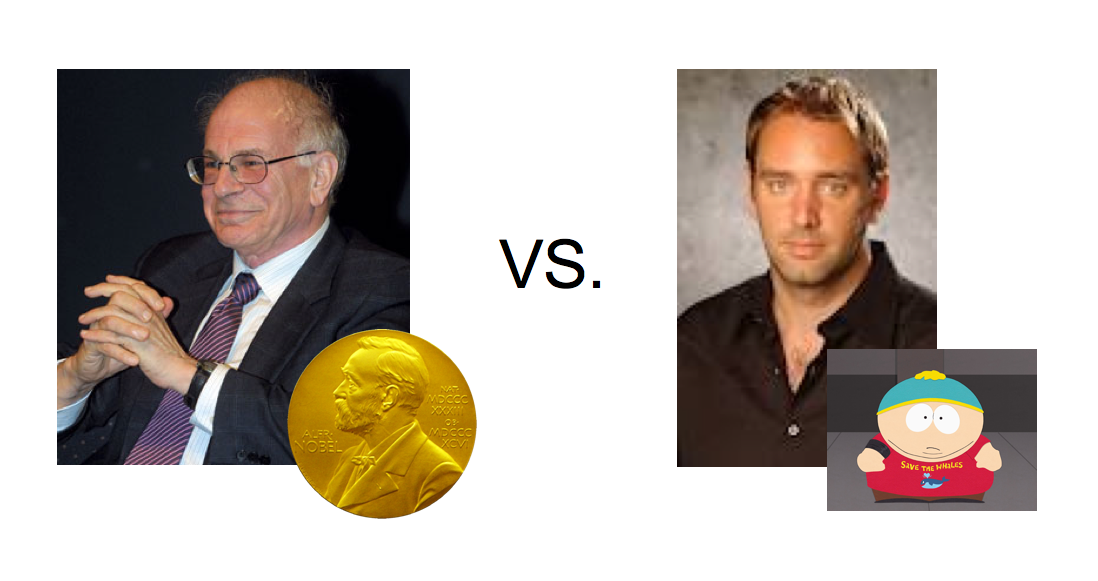 Kahneman’s (left) is the one who talks about System 1 and System 2. Here you have it personified. He’s System 2, Trey Parker (right) is System 1. Who you gonna call?
ghosters
KAHNEMAN POOPS ON THE NATIONAL ACADEMY’S GREAT SCIENCE COMMUNICATION CONFERENCE
It’s a conundrum and it ain’t that new. I spent the weekend slowly, meticulously, thoughtfully reading Oscar Wilde’s classic and only novel, “The Picture of Dorian Gray.” He wrote it in 1890. His father was a prominent surgeon and he was the most celebrated playwright of his day. Clearly he had the split brain — half thinking, half feeling — more so than most. And it pervades his every word in Dorian Gray. Here’s a great quote:
aaaaa“I wonder who it was defined man as a rational animal. It was the most premature definition ever given. Man is many things, but he is not rational. I am glad he is not.” – Oscar Wilde, “The Picture of Dorian Gray” (1890)
That was 120 years ago. Now compare that with with this quote from Daniel Kahneman near the end of his talk just two weeks ago which Andy Revkin posted here.
aaaaa“Because of emotional coherence, the source of the message is extremely important, the source has to be liked, and the source has to be trusted, and if the scientific establishment is not trusted, then the amount of evidence really is going to have very little purchase on what is going to happen.” – Daniel Kahneman (2012)
He’s talking about “likeability” which by definition is not rational. He’s saying man is not a rational animal. He’s reiterating Oscar Wilde, just in more technical language. Nuttin’s changed.
dog
RIGHT SPEAKER, WRONG CONCLUSION?
So I’m guessing the organizers of the N.A.S. conference, given their title of, “The Science of Science Communication,” were hoping that Kahneman would play to the “scientism” precepts (the idea that EVERYTHING has ultimately an underlying science which if we can just work hard enough to discover we can solve all the problems of the world through science) and deliver the big statement of: “Just keep going with all the science of science communication you can manage!”
But to the contrary, he pretty much just echoed Oscar Wilde — man is not a rational animal. He just put it into more technical language of his Systems 1 and 2. In the end, same deal. Same as my boring book. Come down out of your head. It’s the ONLY hope for the science world. Enough with the misguided motto of, “Make Science Sexy.” Sorry, wrong message. The correct message for today — which is EXACTLY Kahneman’s message — is “Make Science Human.” Which means yes, emotion and humor, but it ALSO means INTUITION.
And yet, the title of one of the major talks at the NAS conference was about getting RID of intuition. Did it occur to anyone present that Kahneman’s entire thesis was 100% opposite of that title?
What a mess. When eggheads collide.
And if you want the definitive proof of how entirely misguided the whole science communication world is, just look at this new Gallup Poll that came out on Friday about attitudes towards evolution in the U.S. It shows that over the course more than 30 years, despite all the public programs and books shouting, “EVOLUTION IS A FACT” the change in public attitude is … pretty much nothing.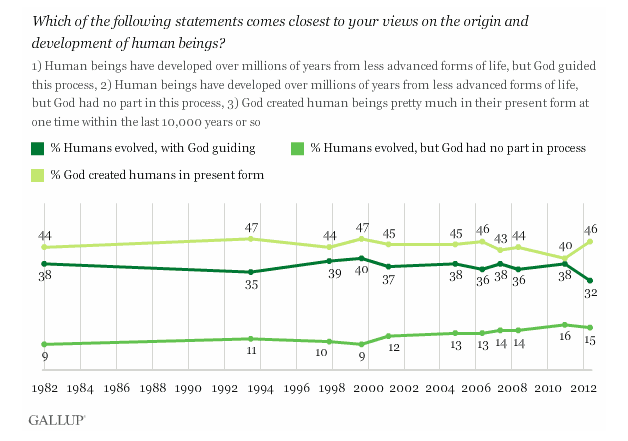
NUTTIN’S CHANGED. How strange is that? Since 1982, despite all the public programs promoting evolution as “a fact” in America, the numbers are pretty much the same, with only about 15% of the public buying the academic, secular version of evolution. Apparently someone needs to shout EVOLUTION IS A FACT even louder.
cat
DON’T LECTURE US, JUST SHOW US HOW ITS DONE … PLEASE
I found Kahneman’s talk pretty dry, and I couldn’t make it through much of his book (he’s no Malcolm Gladwell unfortunately), but it’s great that his talk in the end did deliver a solid, simple message — science has to figure out how to be human. In film school the most fundamental principle they taught us was, “Don’t TELL us, SHOW us.” And that’s the limit of Kahneman’s message. He’s got the telling part down, but unfortunately he can’t show us what he means.
That falls to people like Trey Parker and that’s who the science world should be calling on to hear a talk that won’t be preaching to the converted. If they have the guts for it.
#216) MALIBU LAGOON: Where are the (controversy-averse) large environmental NGO’s and Foundations?
May 31st, 2012
I have the somewhat grouchy last words at the end of this article yesterday in the LA Times about tomorrow’s scheduled start of the controversial Malibu Lagoon Restoration Project. I’ve been asking for a year, “Where are the big guns?” This nation has environmental NGOs and foundations with the resources capable of communicating the bejesus out of this very justifiable and needed environmental project. Why aren’t they here helping?
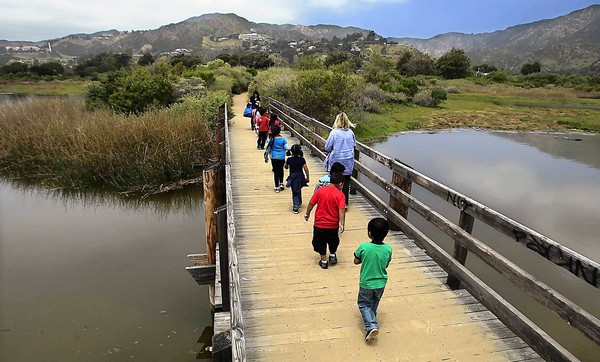 MALIBU LAGOON RESTORATION PROJECT: What does it take for the large NGO’s and foundations to actually engage in powerful communications work as a means of avoiding local environmental conflict?
lagoon
A FAILED MOVEMENT, DEMONSTRATING HOW IT FAILS
Last April, Sarah Hansen published a powerful and precise indictment of the current American environmental movement with her report for NRCP.
Here’s her most painful statement: “From 2000-2009, grantmakers provided $10 billion for environment and climate work, funding primarily topdown strategies; yet we have not seen a significant policy win since the 1980’s.”
That’s the sort of summary statement that supports all the written critiques of “the failed movement” like that of Schellenberger and Nordhaus and plenty of talks such as Peter Karieva’s recent presentation that ruffled normally-comfortable conservation feathers.
yikes
AVOIDING “LOSABLE BATTLES”
I’ll go further. These louts with these bloated budgets have also proven themselves prone to avoid controversy in general. There’s one “C.E.O.” whom I’ve heard speak explicitly of leading his organization to seek, “Winnable Battles,” — meaning sure victories that they can report to their donors as proof that they are “Winning!” even if it’s a campaign to pick up litter in the local dog park with no opponents. Seriously? What a gutless mindset. And the sort of thing I’ve found myself thinking over the past two years as I’ve observed and tried to help out a bit with this somewhat crazy (yet 100% symptomatic of our current society) controversy at the Malibu lagoon…
Where are the big folks?
You can see the article ends by pointing to this. There has been no clear concerted professional communications effort to help the local community understand why their lagoon does indeed need to be torn up for six months in order to make it function better. Which is similar to what happened with the issue of Marine Protected Areas on the California coast over the past decade. There was also no concerted professional communications effort to the fishermen and coastal residents to help them understand why there is a need to lose some of their favorite fishing grounds for a while in order to replenish fish populations.
What exists are tons of lawyers and lobbyists who know how to get laws passed in favor of the environmental goals, but no ability to translate any of the agenda in understanding for the average folks.
It’s very, very bad. Shame on you, large NGO’s and foundations with your staggering wealth and arrogance. I’m here on the ground watching it and you should not be proud of yourselves for this. You should be still celebrating the 1980 Alaska Lands Legislation Package, which as Sarah Hanson points out was your last major accomplishment. That’s it. More than 30 years ago now. Why do you keep patting yourselves on your backs?
#215) Praise the Lord and Pass the Innovation
May 21st, 2012
Just back from 2 weeks in New Zealand and Australia (my first time back in 24 years!) where I had a great, great time at multiple venues including the excellent, “Collaborate, Innovate” conference in Adelaide.
 PREACHING THE GOSPEL OF INNOVATION at “Collaborate, Innovate” in Adelaide, Australia.
woot
PRAISE THE LORD AND PASS THE INNOVATION
For starters, the above line is a tribute to my excellent assistant/videographer/special effects editor Josh Forgy whose grandfather, Howell Forgy, 70 years ago, was the chaplain on board the U.S.S. New Orleans at Pearl Harbor and coined the famous expression, “Praise the Lord and pass the ammunition,” in the midst of the bombing.
And speaking of which, this is a big week here as we’re doing our first test screening of my new documentary feature film about World War 2, but for now I’m recovering from a very busy two weeks in Australia, the highlight of which was the “Collaborate, Innovate” conference in Adelaide. Here are a few photos from my talk.
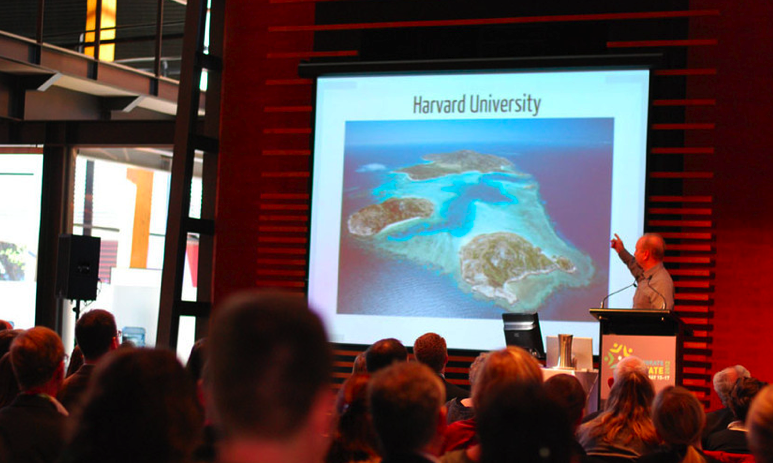 THINK VISUALLY. I’ve used this slide in about a dozen talks in the U.S. without eliciting a response, but in Australia the audience laughed, apparently ignoring what I was saying (that I did my graduate field work at Lizard Island in the photo), and instead thought I was suggesting that Lizard Island is a branch campus of Harvard.
 PREACHING FROM THE GUT. In the photo, Arnold is wearing what in Australia is known as “budgie smugglers” (budgie being a parakeet).
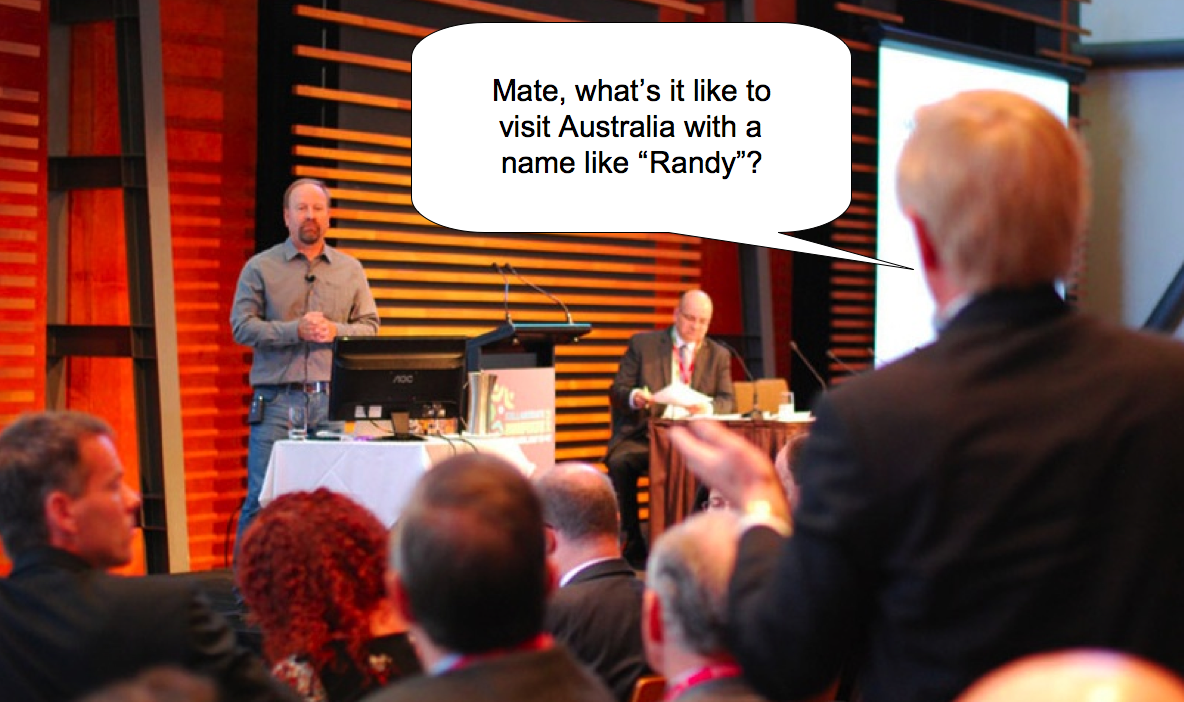 I’d forgotten this one from the old days of field work on the Great Barrier Reef — once when I had to give a talk to the Deputy Prime Minister of Australia, this was the only question he asked.
#214) It’s Time for a Boredom Czar for Global Warming
May 4th, 2012
How boring does global warming have to get before Obama finally appoints a Federal Task Force on Boredom? We need a Boredom Czar. We’re destroying our planet with the force of a thousand Ambien factories.
 HEADLINE: PENILE ABUSE PREFERABLE TO ARGUING ABOUT CLIMATE. In this Australian video, “I Can Change Your Mind on Climate Change,” British science journalist Ben Goldacre says in reference to the topic of global warming (at 48 minutes), “I would literally rather slam my cock in the door than to get involved with this.” Ouch. That’s how boring it can get.
yawn
BORING IS AS BORING DOES
I just keep saying this over and over and over again. Until I bore myself. Global warming/climate change is the most god awful boring topic to ever confront the human race. I knew it ten years ago when I first starting talking to professors about it and it’s far worse today.
If there’s any nation that might possibly rescue the topic from the garbage can of total tedium I’m willing to bet it would be Australia. Here’s a film that was recently produced there — titled, “I Can Change Your Mind on Climate Change,” I started out watching it thinking I could only take about five minutes of it, but actually ended up hanging in there for the whole ride. I have to say it’s enjoyable and relatively interesting.
They do a good job of casting the two stereotypes — the bleeding heart young woman versus the cranky/angry old man. Both are great. They have them visit “the usual suspects” including my buddy Marc Morano (who is in my movie “Sizzle“), Richard Lindzen, and Bjorn Lomborg. It’s a decent film that holds your interest and shows you how hopeless the whole predicament is at the moment.
in that moment
SASHA BARON COHEN AS LORD MONCKTON
But this is really what I mean when I say that Australians have the ability to make this stuff at least somewhat unboring. I think I would vote this short piece, punking goofball climate skeptic Lord Monckton (which has almost a half million views) as the very best piece of media on the global warming controversy to date. It’s utterly brilliant. Way to take a buffoon and play to his vanity.
I’m headed to New Zealand then Australia, spending 3 days each in Sydney, Adelaide, and Canberra. The highlight of the trip will be the Collaborate Innovate conference in Adelaide where I’ll be giving a talk and running a workshop. It’s my first time back in Australia in 24 years and all kinds of hijinx are lined up. Really looking forward to it. Especially getting back to the old Australian sense of humor and cynicism. They have such a healthy outlook on life, know how to not take themselves too seriously and drink plenty of beer along the way. Great to be going back.
There’s a great new documentary coming out about the controversy surrounding the Texas School Board and their control of textbook content. It’s the new feature documentary, “The Revisionaries.”
 To see the trailer for the new feature documentary, “The Revisionaries.” click HERE
space ghost
A TEXAS-SIZED CONTROVERSY OVER TEXTBOOK CONTENT
Filmmaker Scott Thurman of Texas has a new documentary feature film that he’s been working on for a few years (he contacted me a while back about it) which just won a Special Mention at the Tribeca Film Festival, which is great news. The “star” of his movie, Don McLeroy, head of the creationists efforts in Texas, was a guest on The Colbert Report earlier this week.
Congratulations, Scott! Hopefully they’ll get a distribution deal and you’ll be able to see it at your local theater soon.
#212) SCIENCE vs. HOLLYWOOD: Still two different worlds (for now)
April 26th, 2012
You won’t see a prominent scientist publicly discussing personal phone etiquette. Yet.
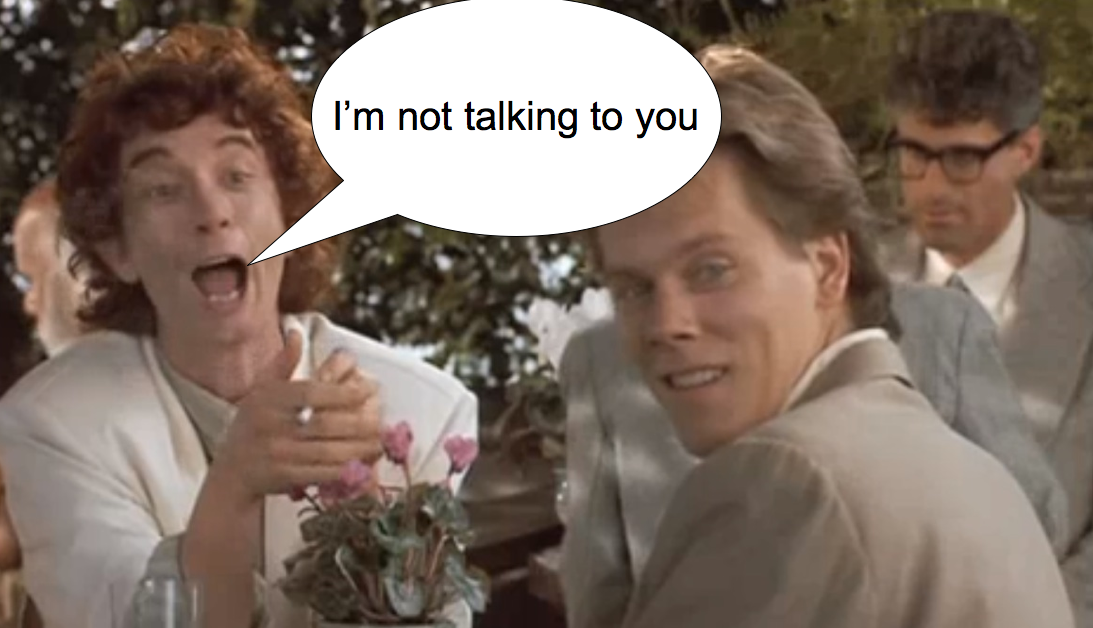 ONE OF THE GREATEST HOLLYWOOD CHARACTERS. Martin Short as Kevin Bacon’s uber-flakey agent in, “The Big Picture.”
lol
THE HOMOGENIZATION GENERATION
When I moved from academia to Hollywood at the end of 1993 (nearly 20 years ago, yeeks!), the cultural differences between the two worlds were profound. Today, not as much.
The internet was just getting started back then, almost nobody had cell phones (pagers were the rage), and email was just taking off. Pretty much all “films” were still being shot and edited on actual film, not video.
In the years since, the computer has proven to be an enormous agent of homogenization. When I introduced the first batch of Scripps grad students in oceanography to Final Cut Pro (a widely used video editing program) in 2005, I warned the faculty there might be some problems, but there weren’t. They picked it up in a heartbeat — why wouldn’t they? Its just another program on their Mac laptops. Had I tried to show them how to use a Steenbeck film editing table (where you manually cut the film with a razor blade and tape it together with tape) it would have been days of pain and suffering. Times have changed.
But as similar as the various worlds of science, Hollywood, and everything else in our society have become, there are occasional reminders that the social dynamics have still not quite converged. Here’s a prime example.
hush
I’M NOT TALKING TO YOU!
Check out this item this week from Hollywood super agent Gavin Polone talking about “phone etiquette.” He makes no bones that there are people on his list whom he simply is not speaking to right now and will not return their calls.
Try to picture the day when a prominent scientist — say the Director of NIH or NCI or NASA interviewed in Science — talks about the people whose calls he’s not returning. You know they show the same behavior, but it’s still a different world, but for how long? Again, the lives of top scientists today look much more similar to the lives of top Hollywood moguls today than they did a couple of decades ago.
For better or worse, the world continues to homogenize itself.
#211) BEACH PLASTICS: A motivational video, which is good enough
April 24th, 2012
Here’s a really nice, fun, creative video with a great sense of lightness and humor about a depressing problem. It isn’t full of instructions on, “What you can do.” But it doesn’t need to be.
MOTIVATION IS ENOUGH. Nice video. Makes you want to learn more. Mission accomplished.
plastic
AROUSE (MORE THAN FULFILL)
It’s so hard to get anyone’s attention in today’s world. The KONY 2012 people knew this, and did an impressive job of addressing it. They have succeeded in giving their subject “name recognition” that is worth its weight in gold.
So above is a cute little video about plastic trash on beaches. No, it doesn’t end with a long detailed list of “What You Can Do,” but so what? If you’re one of the people who think you’ve spotted the fatal flaw in people’s efforts because they don’t present their “What You Can Do” laundry list, you’re probably coming at this stuff from too cerebral of a place.
Al Gore’s movie, “An Inconvenient Truth” is dismissed by many as ineffective because it didn’t tell everyone enough at the end of the film what to do to solve the problem; however, that’s not the strength or purpose of film/video as a medium. That’s what websites and written materials and public speakers are for. Films are better off simply as motivational tools, to get people inspired to seek out the resources to guide them into action, rather than trying to bog the film down with a bunch of information.
I don’t know how many times I can say this — film is not an effective informational medium. Use it for motivation.
Towards that end, this is a great video. Mostly motivational, which is fine.
#210) Malibu Lagoon: June 1 Showdown Looms
April 20th, 2012
Really unfortunate situation. The best available science recommends digging up the lagoon for “restoration.” A very vocal local faction opposes it and has done an impressive job of “framing” the issue on their terms, labeling the environmental groups as developers by using the “Stop the Bulldozers” slogan. Construction is set to begin on June 1. Opponents are vowing to block the bulldozers by chaining themselves to them. Tick, tick, tick.
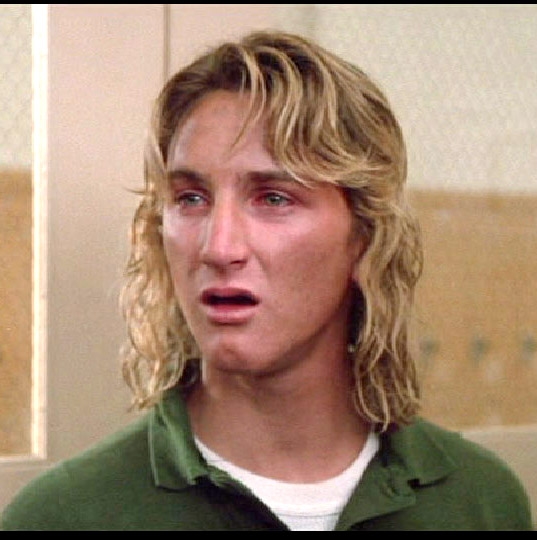
 JUDGE SPICOLI RULES. There were three surfers who ran in the last election for City Council of Malibu with one of them winning the election. He’s Skylar Peak, 27, great guy and son of the late Dusty Peak whom I interviewed in 2009 about the Marine Protected Area issue around Malibu — a very committed conservationist. (illustration from yesterday’s article in the LA Weekly)
brah
STOP THE BULLDOZERS. BOTH OF THEM.
It’s been a campaign with a great deal of distortion and misinformation. The opponents claim the construction will cause traffic nightmares, the proponents say it will only be a couple of dump trucks making a couple of runs a day — how much traffic will that block?
Back and forth, back and forth. The environmental groups gave up on their communication efforts, so I had to as well. Now I’m just a spectator, but saddened that the truth hasn’t been communicated well. In fact, this article yesterday by the LA Weekly ends with the Mayor of Malibu saying exactly this — the science has not been communicated. Bummer, brah.