#209) MOVIE REVIEW: “Confessions of an Ecoterrorist” — great film!
April 16th, 2012
Does anybody remember a time when environmentalists actually did things and had a sense of humor about it? Ocean activist (and I mean GENUINE activist) Peter Brown’s fun new film, “Confessions of an Ecoterrorist,” shows that spirit as he runs through a scrapbook of amazing Sea Shepherd memories.
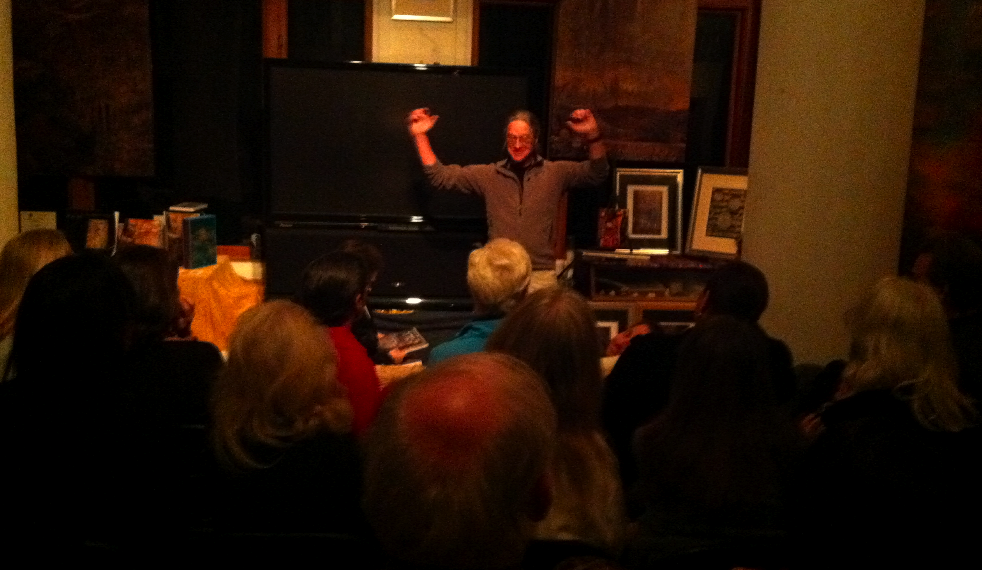 THE OCEAN WARRIOR. Long time ocean activist and Sea Shepherd ship first mate, Peter Brown, fields questions from a very appreciative audience for his new movie, “Confessions of an Eco-terrorist.”
goodness
BACK WHEN ENVIRONMENTALISTS WEREN’T BORING …
The American environmental movement lost the bulk of its heart and soul in the 1980’s (yet another sad byproduct of Reagan’s ravaging of the nation), but if you want a glimpse of how things used to be, you can still see it in the inspired, sometimes zany, antics of Paul Watson and his band of merry sea life defenders, Sea Shepherd. A number of their most inspiring adventures are presented in the new film, “Confessions of an Ecoterrorist,” by Watson’s long time lieutenant and media mastermindererer, Peter Brown.
On Saturday night I attended a local screening of the film where Peter Brown spoke afterwards. He’s one of my new heros.
In 1982, as a producer for NBC, he did a segment about the Iki Island dolphin slaughter where he encountered Sea Shepherd. He became an immediate convert, formed a friendship with their legendary captain, Paul Watson, and the rest is history as he alternated years of ocean activism (and in the case of Sea Shepherd the word “activism” means a lot more than just writing blog posts) while continuing to produce major television shows (like the most popular show on TV, “Real People” for 4 seasons, and “Entertainment Tonight“).
All of which made him a highly qualified environmental warrior for today — one with inside knowledge and connections in the media/entertainment world. As he says throughout the film, “our cameras are our guns.” No environmental organization understands mass media as well as Sea Shepherd.
So if you loved or even liked, “Whale Wars,” (personally I loved it) you’ll really enjoy this film. Actually, I might go so far as to say it’s better than watching, “Whale Wars,” primarily because it doesn’t quite take itself as seriously. Peter Brown is the host, and at first it seems to start off with corny jokes, but after a while, a lot of the jokes are not only funny (he had the crowd roaring and cheering), the humor becomes poignant and hits a crescendo when the Ecuadoran Navy in the Galapagos Islands gets so spooked they end up accidentally leaving behind a crew member on the Sea Shepherd ship, standing forlorn on the deck in his white uniform after his ship has forgotten him.
oh my gooodness
SAVVY MEDIA VETERANS AT WORK
The film is not only fun, it actually makes you feel good that there are still people in this world who are more interested in doing things, rather than just raising funding from foundations and talking about doing things. Paul Watson and the entire Sea Shepherd crowd are ball busters. And they have so many accomplishments to show for all their efforts, as Brown makes clear in the film (and he doesn’t even go into the major victory they scored recently against the Japanese whaling fleet in the Southern Ocean — I guess because he got “voted off the ship” on that expedition).
When I talk about the right way to communicate to the public for environmental issues, most of what I’m talking about is what these folks embody. They know how to use humor and emotion in a likeable manner. They not only tell great stories, they still actually produce their own great stories. And most important of all, they’re a bunch of feeling, thinking, laughing human beings. They deserve every ounce of support they get, and as Peter pointed out repeatedly, despite all their high seas hijinx, they’ve never lost a person or even had a major injury. Which is not something the whaling industry can claim.
Yesterday morning at Villanova I was greeted by this brilliant piece of graffiti. The movie is 6 years old. Nobody ever quite looked at it this way.
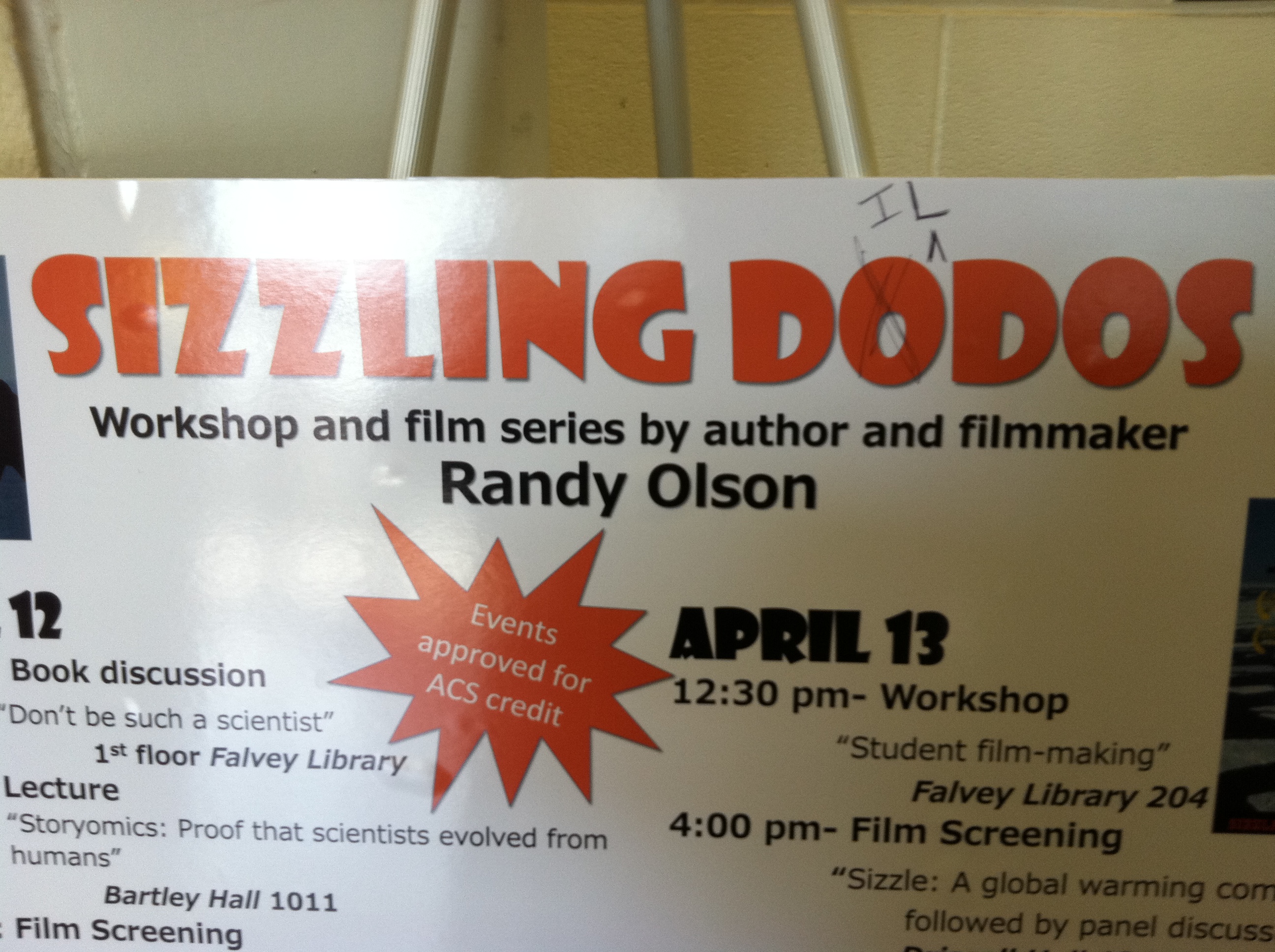
Too good for words.
#207) The Rather Obvious Demise of Intelligent Design
April 6th, 2012
All that fear and hatred in 2005 and for what? Couldn’t everyone tell it was an inept movement that was doomed to beat itself to pieces like the flagellae they so worshipped as examples of perfect design? I never understood the panic element. Whatever. Intelligent Designer and former momentary celebrity Dr. Michael Behe of Lehigh University will be joining the post-screening panel discussion of my movie, “Flock of Dodos” next Thursday at Villanova University. This graph kinda tells their sad story.
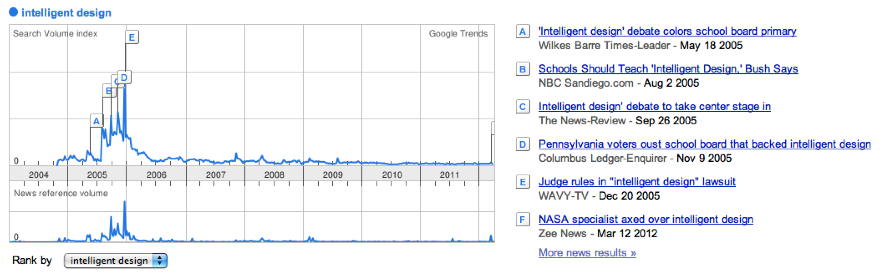 THE MEDIA WORLD GIVETH, AND THE MEDIA WORLD TAKETH AWAY. Here’s a Google Analytics search on “intelligent design.” Yeeks. They had a good run, until a party pooping judge in Dover, Pa. took a sledge hammer to their entire existence in December, 2005. After that you can see they kinda flat lined.
bummer
AN IRREDUCIBLY COMPLEX COLLAPSE
It was such a fun party for them. While it lasted. On August 7, 2005 they scored the cover of TIME Magazine with a huge feature article that painted the picture of a movement that was setting the world on fire. The only problem is what happens to things that are on fire — they eventually burn out. Especially when they explode first, as was the case in December of that year with the Dover Trial. Ouch.
Interestingly, in August, 2005 I was set to interview Stephen Jay Gould’s widow, Rhonda Shearer, but she decided to cancel the interview, saying that, “Steve always said there’s no point engaging with these people, it will all be settled in court.” She was right. I didn’t know then the Dover ruling would prove to be so dramatic, but it has been. They got their spine snapped. They’ve been directionless on the topic of intelligent design (though of course still scurrying around, attempting their anti-evolution hijinx at every textbook ruling opportunity).
yikes
DR. MICHAEL BEHE ON VILLANOVA DODOS PANEL NEXT THURSDAY
Late next week I’ll be at Villanova University with yet another Sizzling Dodos visit. We’re screening Dodos on Thursday night and Sizzle on Friday afternoon. The Dodos post-screening panel discussion will be Dr. Michael Behe of Lehigh University, Faye Flam (science journalist from Philadelphia Inquirer), Dr. Aaron Bauer (Villanova evolutionary biologist) and myself.

This will be the first time Dr. Behe will attend a screening of the movie, and my first time seeing him since our lengthy two hour interview on a hot summer day at Lehigh University in August of 2005 — right at the height of the intelligent design fury. He was a good sport to take part in the movie, and he’s a good sport to attend this event. And I will never quite understand why so much hatred and bile was spewed at him by evolutionists. A lot of them should be ashamed of themselves for it. For me personally, I received far more hatred from scientists than from the bungling kooks behind the intelligent design movement.
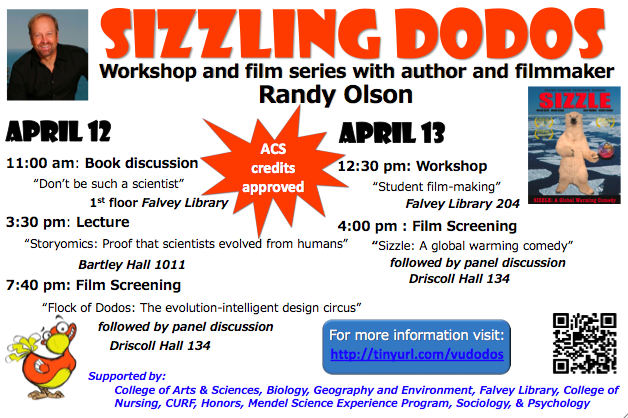
DODOS IN PHILLY NEXT THURSDAY NIGHT with a panel discussion featuring intelligent designer Dr. Michael Behe.
#206) KONY 4: The problem with “Metrics Obsession”
April 4th, 2012
Don’t dismiss the Kony 2012 campaign as a “flash in the pan” until you’ve given plenty of thought to the power of name recognition (and how hard it is to quantify)
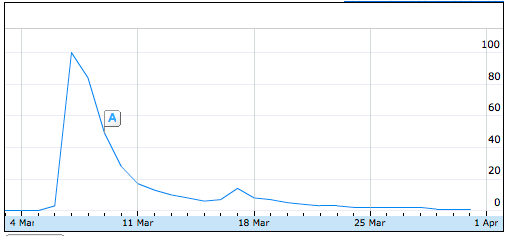 FLASH IN THE PAN? NOT SO FAST. Everyone was quick to dismiss the KONY 2012 campaign based on the almighty “metrics” like this one from Google Analytics that shows a flurry of attention and what appears to be a loss of interest. But “name recognition” has a much longer effect and is hard to quantify. Think of this graph as being like a graph of “infection exposure” for a disease that makes you aware of the name Kony. A whole bunch of people were exposed quickly, and I mean a WHOLE bunch. More importantly, people need to be exposed only once to learn the name (which is extremely important in today’s noisy world), so if you think of this as a graph of exposure, you don’t need the level of activity to stay at a plateau. Just hitting the key crowd once is sufficient.
hit
THIS IS THE PROBLEM WITH “METRICS-OBSESSED” ENVIRONMENTALISTS
From the very start of our Shifting Baselines Ocean Media Project in 2002 I began hearing from environmental folks the proud and defiant question of, “So where’s yer metrics, dude?” It’s a question that’s both reasonable AND the source of the movement’s colossal failures to communicate these days.
What this means is that we’re not going to believe any thing you say is gonna work, or anything you did has worked, unless you show us hard, cold numbers. Which is the definition of “gutless” meaning you have no gut instincts whatsoever, you only know how to look at data and draw the same conclusion that anyone else would.
As soon as you develop this philosophy you’re pretty much doomed.
brains
ZOMBIES WITHOUT METRICS
I’ve raved a lot in the past half year about the CDC’s awesome Zombie Disaster Preparedness Campaign. It sprung to life last May from a GUT INSTINCT. Not from metrics. Not from data. Just from three very cool people who had this powerful revelation that to motivate a certain part of the public to take an interest in the topic of disaster preparedness, literal mindedness (i.e. beating people over the head with the simple facts) had limited effectiveness, but there existed this extremely non-literal way to approach the problem (to match it with the idea of preparing for a zombie attack) that was explosive.
But as soon as they created their media attention mushroom cloud (they scored over $3 million free media coverage off a budget of $87), the metrics-obsessed sharks began circling. I’ve gotten a taste for what they’ve encountered when I’ve presented their amazing story in my talks. Almost every time, there is some proudly, defiantly skeptical person in the audience who asks, “Yes, but do they have ANY data to show that their project has actually changed anyone’s behavior?”
Well. There’s the old Dylan line, “You don’t need a weatherman to know which way the wind blows.” That’s about all I can think to say in response to that question. If you’re out in your driveway with branches from trees to the west of you flying at you at high speed, you really don’t need “the metrics” to be able to say the wind is blowing from the west. And when you score $3 million in media exposure it’s not “hot air” as many like to say. In today’s world, “attention” is THE currency (just read Richard Lanham’s book, “The Economics of Attention”).
gore
AL GORE HAD NO METRICS
A couple years ago at a workshop in D.C. I made mention of the courage of Al Gore and his group (despite all my specific criticisms of the movie itself) in stepping up and providing what is still the only clear and prominent voice of leadership for the issue of global warming (though Bill McKibben is slowly approaching a similar level of recognition). When I finished my comments one of Gore’s top people pulled me aside, thanked me for the words, and said it was absolutely true — there were no metrics that drove Al Gore, Laurie David and Lawrence Bender to make that movie — only a clear gut instinct that this was an important issue that the climate science world was failing to communicate to the general public.
And of course there’s the example I mentioned in my book of Ken Auletta’s great New Yorker article titled, “The New Pitch: Do Ads Still Work” in 2005. He talked about the hopelessness of metrics in an increasingly fragmented and narrow advertising world, then cited the example of Aflac as proof. Their quacking duck campaign arose not from mountains of polling data and surveys, but rather just from an executive with a powerful gut instinct to have some fun with the name of their company sounding like a duck. The rest was history as they doubled their business in four years without changing a thing other than the one ad campaign.
The climate movement is short on gut instinct, long on metrics obsession. That’s a bad combination. They should be watching and learning all they can from the KONY 2012 campaign. If you’re talking about it as a “flash in the pan,” you’re failing to appreciate the power of establishing name recognition in today’s attention-driven world.
It’s the things you can’t quantify (or can’t afford to take time to quantify) that matter most in the end.
As part of my visit to Vancouver last week I got to attend a good old fashioned hippie dippie anti-oil pipeline rally that was really outstanding and even kinda moving. It’s great to see people are still able to step away from their keyboards and actually assemble in public. Plus Bill McKibben is awesome.
SHOW STOPPER. She’s half 11 year old, half Joan Baez reborn. We had to leave before Ta’Kaiya Blaney sang, but everyone who was there talked about her performance for the next two days, making me worry they were over-hyping it. But when I finally saw this video, I could see they weren’t — she’s truly amazing.
space
GOOD OLD FASHIONED PUBLIC PROTEST
I was in Vancouver last week to speak to the wonderful folks at Simon Fraser University, University of British Columbia, and University of Victoria. I think I get more out of the visits than do the people who actually invite me. Each one is like a tutorial that ends up with my iPhone being packed full of new things to read and films to watch and interesting quotes and all sorts of other things.
For this visit, my host Anne Salomon (who gave a tremendous talk last November at the WWF 50th anniversary symposium I took part in) led me down to the Vancouver Public Library in the light rain. The night before we had dinner with SFU economics professor Mark Jaccard who is a major veteran in the struggle to keep Canada carbon conscious and keep the oil companies in check. He was slated to speak for 3 minutes at the big rally and was nervous having never done such a thing before.
I gave him a bunch of advice, to the best of my communications ability, but in the end, I think I probably just scrambled his brain at the last minute. He ended up doing fine, but only with the second half of his talk — not with the first half, which was the part I had offered advice on.
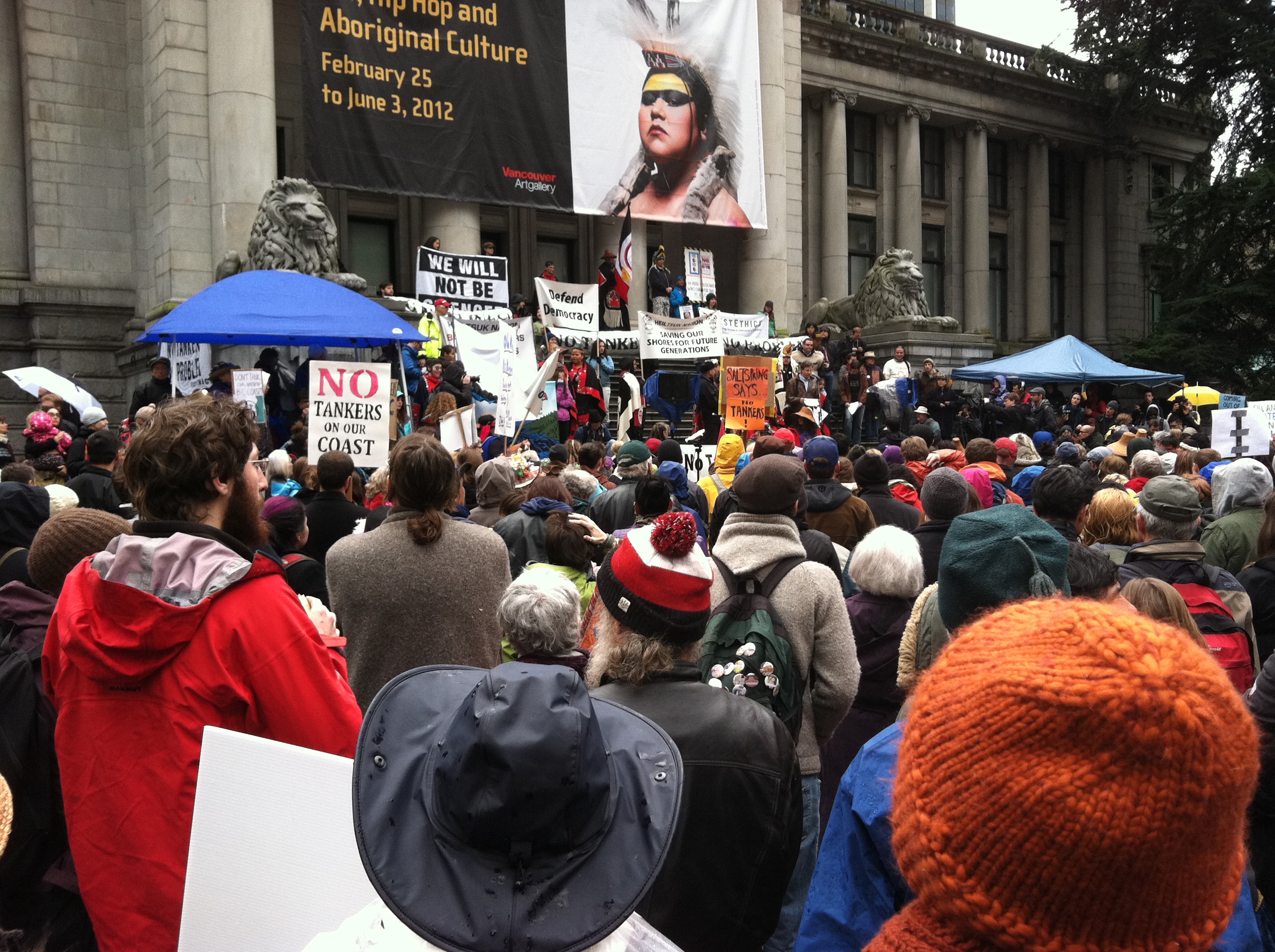
SFU economics professor Mark Jaccard (you can faintly see him just to the right of the orange sign in the center — in brown jacket holding papers) fires the crowd up, recovering from a stumbling start, but then working towards an excellent crescendo.
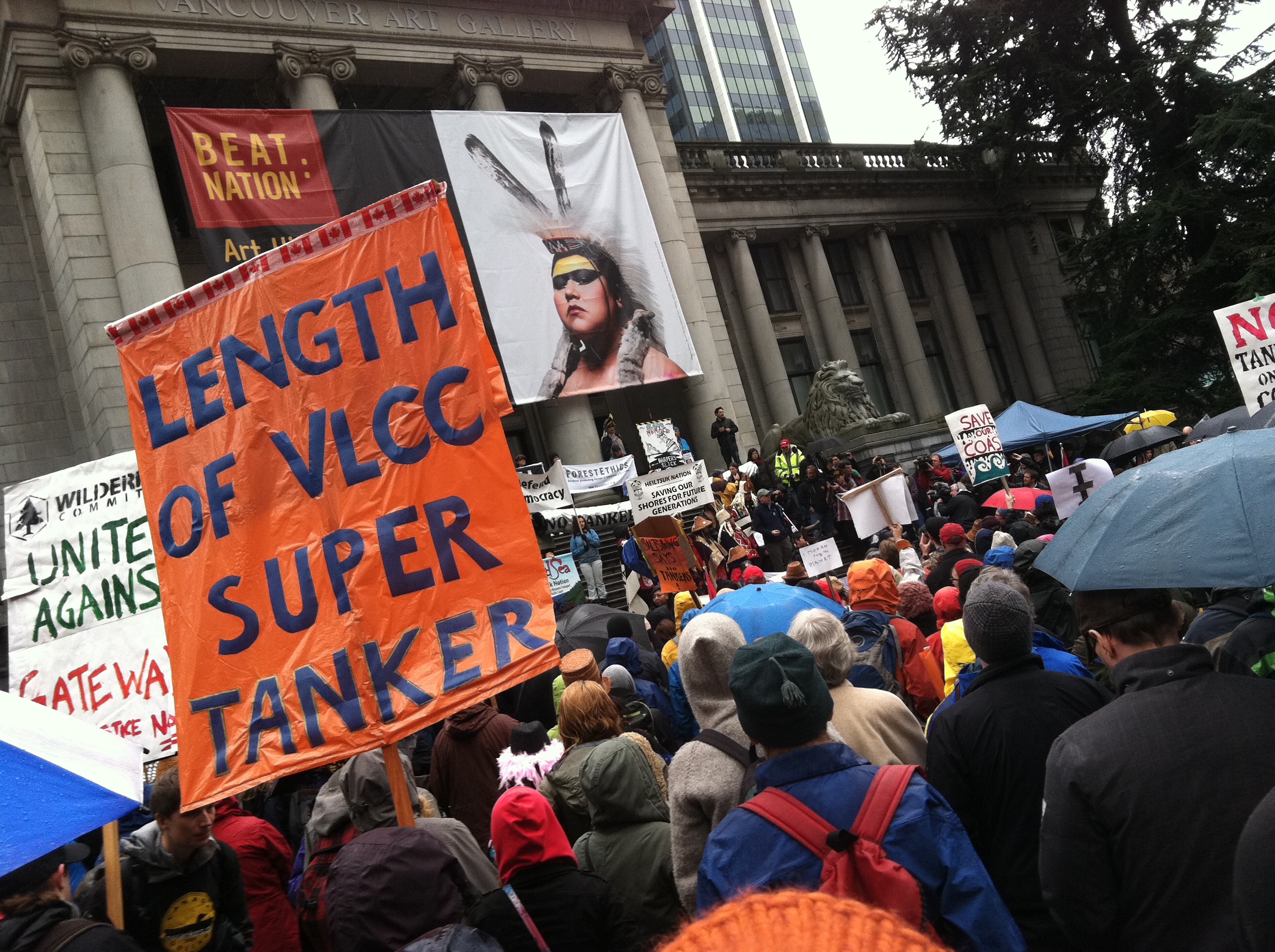 BILL MCKIBBEN – Mister 350 himself slipped across the border to fire up the crowd. His comments were very blunt and very good as he simply told them you cannot trust the oil companies — no two ways about it. Bravo.
 MCSHIT – Lets’ face it, no protest rally is complete without a chick in a McShit jacket.
why
A STAR IS BORN
Actually, Mark’s “performance” made me think of the classic scene of Barbra Streisand in the old movie, “A Star is Born” where she makes her singing debut, starting nervously, fumbling for the words as the crowd starts to boo her, but then she finds her groove and by the end is kicking ass with the audience going wild.
Same thing happened for Mark. He began by saying, “I’ve got some good news and bad news — the bad news is I’m a professor and you have to listen to me. The good news is they’re only letting me have three minutes.” There were scattered chuckles, then his next few lines were kinda boring and made you think, “ugh, he really is a professor.”
But then halfway through he shifted gears with the fairly shocking statement that, “I can see what the future holds, and am afraid its looking like violent protest is going to be inevitable.” Which was a rather non-professorial thing to say. And woke up the crowd as he transitioned into sort of mob-speak, changing from full sentences into short, punchy phrases that began to evoke cheers of “oh yeah!” and “you got it!” which continued to build and by the end he had the entire crowd chanting and cheering for him. Which was awesome!
woohoo
BILL MCKIBBEN ROCKS
Best of all was Bill McKibben. In my WWF talk last fall I railed against the overly cerebral orientation of the climate movement. He’s cultivated the one strongly more visceral element with his 350.org movement. They put on the impressive Tar Sands demonstration in D.C. last fall (which I stumbled into), and he was inspiring again at this rally.
But then we had to go because I had a talk to give at SFU, so we couldn’t stay for Takaiya, but probably just as well as I probably would have gotten all emotional. I can only take so much of rallies like that without getting nostalgic for the 60’s and 70’s. Regardless, it was a great sight to see.
#204) S FACTOR 2: Check out the videos of the event.
March 30th, 2012
The webpage for the S Factor 2 last month in Salt Lake City is now complete — have a look.
THE S FACTOR 2 IN ACTION. Here’s a 6 minute video giving you an overall feel for how the S Factor 2 event last month at the Ocean Sciences meeting in Salt Lake City went. It was great — an excellent mixture of brave new videomakers and a panel doing their best to help improve the level of storytelling. Can’t wait for the next one.
vid
SCIENCE FILMMAKING 101 (BROUGHT TO YOU BY NSF AND ASLO)
The future is now, with the S Factor workshops! In the future, pretty much everyone will be “speaking” to the world through video. Almost as easily as you write an email you’ll be “writing” a short video to convey your thoughts. Plenty of scientists are beginning to realize this, so we’ve put these workshops together to help the process.
There’s two basic steps in making effective videos. First, you need to learn how to shoot a video camera and how to edit the footage together. Then, once you’ve developed the ability to actually make a video, it’s time to move to the next level by having your clips assembled in such a manner as to tell some sort of coherent story that can: 1) GRAB the interest of viewers, 2) HOLD their interest as you lead them along a journey, and 3) PAY OFF their interest by answering the question(s) you posted in the beginning.
The S Factor workshops are an evolutionary process, sponsored by NSF and ASLO, as we slowly work with the science folks to help them produce smoother and more effective videos. We’ll be doing it again later this year with S Factor 3 — stay tuned for details!
#203) KONY 3: Let’s Decide in September
March 29th, 2012
Was the KONY 2012 media campaign just a flash-in-the-pan or a gigantic victory? It’s too early to tell.
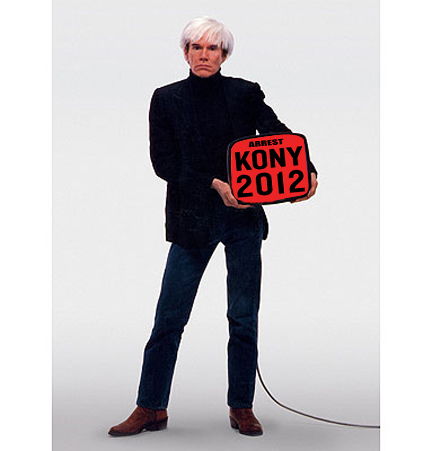 KONY BALONEY OR A MODEL MEDIA CAMPAIGN? Let’s wait 6 months to pass judgement. Gotta see how it shakes out.
yum
ACTION PLANS vs. ENTHUSIASM
I often open my talks with the warning, “For some of this stuff I’m making it up as I go along.” But then I add, “However, in today’s rapidly changing media world, if you’re not making part of it up as you go along, you’re probably not connected with the cutting edge.” There’s just no reliable sources for knowing how things like Twitter work. It’s only been a couple years since everyone went Tweet-crazy — there hasn’t been enough time for textbooks to be written on how exactly it works. You have to try and figure the rules out for yourself. Same thing for the KONY 2012 video.
Last September I was at a dinner party with a few know-it-all blowhards (hmm, wonder why they thought to invite me?) just a few days after the first Occupy Wall Street demonstrations began. These particular blowhards were very confidently opining on the newly born OWS movement which they thought was pathetic, misguided, and certain to be extremely short-lived. They kept saying, “They have no Action Plan.”
Well, I have no “Action Plan.” Never have. Some of us don’t have our lives all planned out — we live it day to day, in the moment, spontaneously, trying to listen to the world around us and make things up as we go along.
So I took exception to their blowhardiness. I pointed out that Action Plans are easy, enthusiasm is rare. Lots and lots of causes have Action Plans that accompany them to their graves. Only a few have genuine enthusiasm.
It’s now more than a half year since OWS was born. No, it hasn’t changed the nation, but yes, they did succeed in creating a symbolic milestone surprising many cities with how broad of a chord they had hit. And they’re not done. The fire is still there, they are maturing, and may slowly be assembling an Action Plan, which is fine.
The bottom line is that there was no reason for the blowhards to pass judgement so quickly on OWS before they could even get off the ground. And I say this because it was much more than just my blowhard friends. I heard the exact same opinions/complaints on lots of news talk shows including my hero Chris Matthews of MSNBC’s Hardball — he said the same thing, “They have no action plan.”
will we?
SEE YOU IN SEPTEMBER, KONY 2012
So I suggest we all hold off judgement on KONY 2012 until six months have gone by. In September it should be possible to say whether it truly was just a “flash in the pan” or whether they scored big by having made “Kony” into a buzzword with enormous name recognition that’s worth its weight in gold. I’m willing to go with the latter. It’s impossible to obtain “the metrics” to reflect the value of such huge name recognition, but suffice it to say pretty much EVERYONE wants it for their cause or products. These folks, complete with their naked masturbating fearless leader, did what millions of others have failed at. I’m willing to bet that by September people will still remember Kony. Marshall MacLuhan and Andy Warhol would be applauding the Kony campaign.
Everyone is so impressed with the stunning communications success of the Kony 2012 campaign. Could it be because they spent more than half their budget on communicating effectively? While not a welcoming thought, it’s how things work in our world today. Get used to it.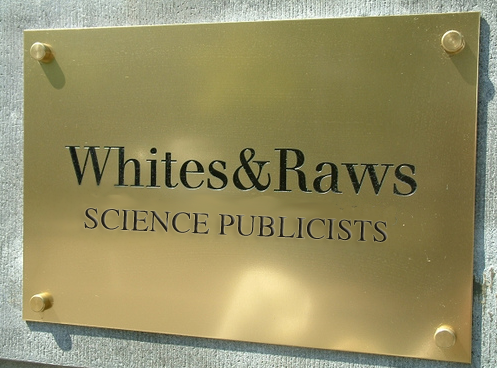
WELCOME TO THE FUTURE. Some day science grants will have the same budget allocations as the Kony 2012 project.
kony
YOU GET WHAT YOU PAY FOR
How many times can you say this? The science world is slowly absorbing the message. When I was a graduate student, NSF grants didn’t require you to spend anything for communication (“public outreach”). Somewhere back around the time I left the science world they began to require 10% of the budget go to outreach.
There’s a crazy schizophrenia going on with this media attention stuff. EVERYBODY wants attention these days (as predicted by Richard Lanham in his excellent book, “The Economics of Attention,” which I quoted a bunch in my book). There seems to be this general ethic that you must scoff at the idea of seeking and gaining attention. And yet .. EVERYBODY wants it.
Even the most self-serious science bloggers, late at night lie awake thinking, “I wish I had more traffic on my blog.” EVERYBODY wants it.
And when something like the Kony 2012 project finally scores it in a staggeringly successful way, instead of taking an honest, objective look at “How did they do that?” large numbers of people attacked, critiqued, vilified and denigrated the campaign. The answer to the “how?” question is simple — they paid for it.
More than half their budget went to communications. Especially if you add in the salaries of their main players and accept that their main activity was making the media that would gain them the prized “attention.”
money money
YOU WANT SCIENCE TO BE POPULAR LIKE KONY? PAY FOR IT
The biggest science organizations contact me for input on communications. When I say, “Pay me,” they balk and say they have small budgets for communication. And yet, they all dream of making, “viral videos.”
Ahhhhhhh … viral videos … just hearing the words is like heavenly music. I want a viral video. We want a viral video. Our organization wants, needs, lusts for, gets down on the floor and grinds their loins for a viral video campaign, with Kony 2012 being the ultimate orgasmic dream fulfillment.
But, alas, they don’t got the money needed to make it happen. But in the future they will. You watch. That 10% for outreach for NSF will grow to 20, then 30, then 40, then the day will happen when half of the entire budget of an NSF grant will go to hire a p.r. firm, web design firm, graphics firm, communications consultant, and personal publicist for the principal investigators.
You laugh. It’s not that far off. The only question is how much kvetching from the scientists it will be accompanied by.
#201) KONY 1: The Perfect Villain
March 21st, 2012
I’ve spent two weeks taking in the Kony 2012 phenomenon. It’s not all bad, but it mostly is.
 HITTING THE JACKPOT WITH KONY. The guy is storytelling gold. Enormous studios in Hollywood dream of finding such a perfect villain.
evil
“YOUR STORY IS ONLY AS GOOD AS YOUR VILLAIN IS EVIL”
In film school at USC I had the good fortune of taking Frank Daniel’s script analysis class. He was one of the legendary instructors. He created the 8 sequence model for screenwriting. David Lynch spoke at his memorial service and credited him for much of his success. The guy was amazing.
One of the basic rules I remember him saying many times is, “Your story is only as good as your villain is evil.”
So now take that basic rule of storytelling and think about Joseph Kony. Is there any better villain in the entire world right now? The founders of the Invisible Children organization realized this. When you combine this element of FEAR, with the element of HOPE, examined by Teju Cole today on The Atlantic‘s website, you get the classic Hollywood screenwriting combination of “Hope and Fear” that is at the core of most powerful storytelling. When you get that, you get to ride the rocket to communication success as the Kony folks have done.
EVERYONE is always desperately searching for a good villain. Just look at Hollywood where they have been run through the wringer over the past few decades, forced to let go of almost all ethnicities as bad guys. As soon as you try to make your bad guy an Italian American or Muslim or Eskimo you’ve got their respective anti-defamation group coming after you. But there ain’t nobody gonna come after you if your villain is a guy who makes children eat their parents or whatever they say he does. Kony is storytelling gold.
And once you find someone that everyone can agree is pure evil, then the masses love nothing more than joining together and forming a lynch mob. Which is kinda what they were creating through the internet for Kony, with a spirit of, “Yeah, let’s go get him, through our keyboards!”
A lot of people are asking what can be learned from the success of the Kony 2012 video. There are some things, as I’ll discuss in the next essay. But just be aware that fear is the number one motivational factor and you aren’t going to find a much better villain to light the bonfires of fear in the masses than Joseph Kony. He’s the jackpot. So of course the Invisible Children organization cashed in on that (until their leader ended up last Thursday running naked through the streets masturbating — roops!).
He’s the #1, very best communications resource the science and engineering world has.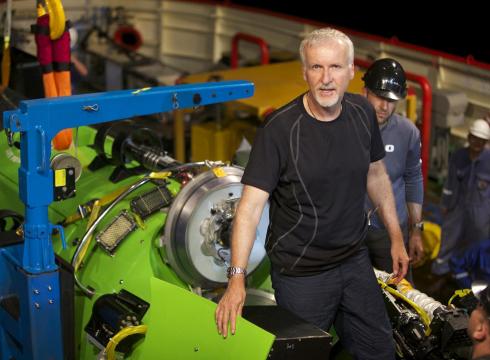
Not sure the science world has ever had a more powerful popularizer than this guy. Yes, there are lots of very enthusiastic science popularizers, but none with the sheer media muscle combined with the 100% joy and enthusiasm for it all.
word
TODAY’S JACQUES COUSTEAU, ONLY MORE SOPHISTICATED
James Cameron is the real deal. You want to know who’s the best voice for the oceans specifically and science in general? He’s your guy. When you look at how incredibly active he continues to be, you see he’s kind of like Superman — able to descend deep oceans in a single vessel, more powerful than the entire movie industry. Look! Down in the sea! Its a fish, its a whale, no, it’s Super-Cameron!
As if making the two highest grossing movies ever — both of which were technological marvels — weren’t enough … now he’s poised to descend to the deepest depths of the oceans.
I can tell you his enthusiasm is real and is rather astounding. In 2003 I was part of a group from Scripps who met with him to look at some clips of his deep sea hydrothermal vent footage he was loaning them for an exhibit. We were warned he was very busy and could probably only manage about 15 minutes. But once he started showing clips, well … it turned into 3 hours, literally. As the scientists identified the creatures in the footage and told him about the science, he got more and more excited, calling up to the projection booth asking them to show one clip after another.
Truly a little kid. His long time assistant told me later if Jim could have his way he’d retire from the movie business and just explore oceans and space for the rest of his career. As he’s about to do with this deep dive. He’s amazing. He’s better than Sagan for today’s world.