#159) An Inconvenient Punishment
October 11th, 2011
The DVD of “An Inconvenient Truth” needs to come with a sticker that says, “WARNING: Cod Liver Oil Inside”
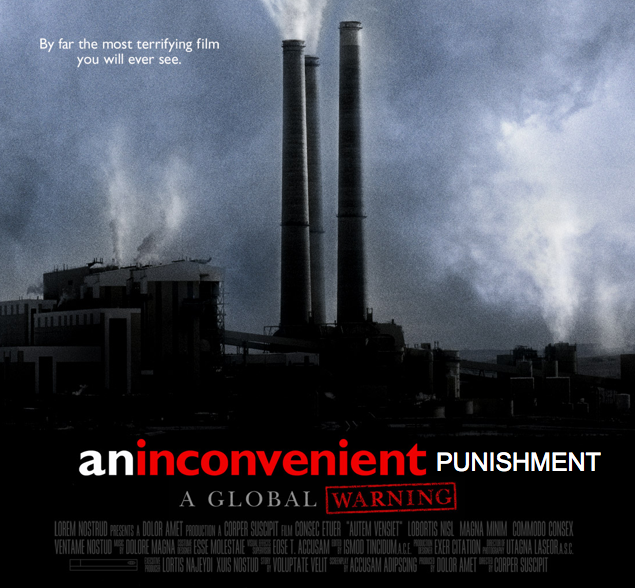
SCARRING A GENERATION
This essay isn’t driven by me — it’s driven by the people who send me emails. Last week I received yet another email from a college instructor who said, “These poor kids have to watch ‘An Inconvenient Truth’ during their lab.” She’s in Rhode Island. I can put you in touch with her if you need a validation of this. And lots of the other folks who write to me saying the same. She was asking me to give her a copy of my movie “Sizzle” as the antidote for the students.
This isn’t an exaggeration. I get a lot of these emails (along with the comment, “thank you for bringing some humor and lightness to this painful topic”), plus we hear it at Sizzle screenings, and during my university visits. Yes, I know I’m supposed to be a cheerleader for the climate movement and not be so critical. And I am still cheering for Al Gore — I think he’s the only true POTENTIAL leader in the movement, as I’ve said here and here. But his movie is bad news. Plain and simple. No two ways about it. And it’s damaging the psyche of an entire generation by forcing kids to watch a movie that begins with maudlin music talking about the mid-life depression faced by a tired old man after he got cheated out of the White House. Once again (I’ve said this MANY times) it is NOT a movie for children. It just isn’t.
When the National Science Teachers Association refused to distribute the 50,000 free copies of the movie that producer Laurie David tried to give them, they stated “non-endorsement” as their major criteria, but they really should have cited “child abuse.”
A handful of hardcore nerd kids love the movie — but they are already obsessed with the topic. The problem is what happens with the rest of the kids. It’s bo-ho-horing to the nth degree. And that’s what they will associate with the entire topic of global warming and climate science afterwards. Which simply should not happen.
space ghost
LIKEABILITY — THE MOVIE LACKS IT, BUT IT’S ESSENTIAL
Last month I spent a wonderful week at Cornell University doing all sorts of talks, screenings and discussions. One of the highlights of the week was visiting their Science Center. It’s a really great facility. One of the most interesting things I heard about was the sort of phenomenon of “resonance” (or whatever you want to call it) that happens for them with kids who grow up going to the Science Center where they always have a huge amount of fun. When they get to college, they come back to visit and feel a warmth and nostalgia for the place. They end up coming back and working as volunteers, saying they love the place because of those great childhood memories.
THAT is the sort of conditioning you want to achieve. Which is the complete opposite of college kids hearing about global warming and thinking, “oh, crap, that makes me think of that depressing adults movie they forced us to watch in 7th grade.”
Nothing like turning off an entire generation to what has been billed as the greatest threat to humanity.
#158) CREATING MOVEMENTS IN TWO STAGES: The Savvy of “Occupy Wall Street”
October 10th, 2011
“They have no message” — if you’re saying this, you’re probably a Nerd Looper
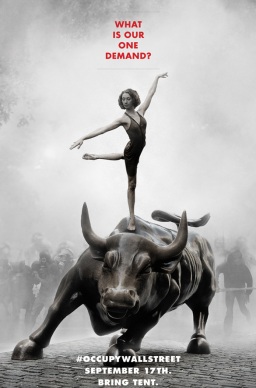
AN OBJECT OF BEAUTY (the Occupy Wall Street movement). Last year I whined about, “Where are all the demonstrations?” after the Gulf oil spill. The fear was that people have gotten so complacent with their online activism that they no longer want to go outside. This is one of the many refreshing things about the Occupy Wall Street movement — proof that people are still able to pull themselves away from their laptops. Yay!
tent it up
BUT YOU HAVE TO HAVE A MESSAGE (no you don’t)
Three weeks ago I was sitting with a group of people who were talking about the very start of the “Occupy Wall Street” movement. One rather obnoxious person very confidently said, “They’re a big waste of time — they have no message, they’re not organized, they should just go home.” Wrong. Demonstrably wrong now, three weeks later as you can see the significant amount of success they are experiencing in grabbing national attention.
That person’s critique makes me think of the most common criticism I heard from environmentalists of Al Gore’s movie, “An Inconvenient Truth.” So many times I’ve been in discussions and said, “I have some criticisms,” and someone else says, “I know, it was such a great movie, but then it got to the end and they didn’t have a good set of instructions of what you should do.”
Well, no. I completely disagree. It was not a good movie as far as movies go (see my standard critique), but it did succeed in stirring a following, and for that it didn’t need any instructions or message or anything specific at the end of it. If you think it did, you’re probably a Nerd Looper.
CREATING A MOVEMENT IN TWO STAGES
Who cares how the movie ended. It succeeded in the same way the Occupy Wall Street movement has succeeded. And same for the Tea Party. All three of these groups managed to achieve the “arouse” part of the “arouse and fulfill” couplet. The question is whether they are able to move to a second stage and formalize their enthusiasm into a long term movement. It’s pretty much the same as the shift in a new business from the start-up phase to the long term operation.
This kind of matches what I presented in “Flock of Dodos” with the figure that shows how an idea begins as a piece of intuition, which is not science and starts down in the gut, but then for it to turn into science (or a formal movement) must migrate upwards from the gut to the brain. Drawing on the small business parallel, it’s the transition from all the excitement of launching a new product to actually making things work over the long term.
The thing that I think is a shame with Al Gore is that he wasn’t able to put together a really, really good second movie that he could have released in 2008 which would have moved the enthusiasm generated in 2006 into a more formal mass movement. In November 2008 Gore was quoted in the NY Times saying that while his movie succeeded in creating awareness, it failed to create the sense of urgency needed to produce the mass movement they had hoped for.
Actually, what they did do in 2008 was spend a huge amount of money on lame-o television ads with political opposites sitting on a couch reading a script saying they agree about climate change. Which didn’t work.
TOO MUCH TO GET YOUR ARMS AROUND?
Last year Sharon Begley wrote an essay in Newsweek which ended with her drawing parallels between the Wall Street mess and climate change. At the broadest of levels, there are a lot of similarities. Both Wall Street and climate are problems that involve gargantuan amounts of information — so much that you wonder whether anyone really can in a single moment completely grasp the entire situation.
That was certainly the case for Wall Street where the role of “derivatives” and all sorts of other complex functions created a system for which there were simply too many cogs in the system to take it all in at once. Same for climate change. Just try following the average topic of debate on the blog Real Climate (which is perhaps the most highly regarded climate blog). It’s largely impenetrable to the average reader (the current topic is “spectral polar cartography”) yet it is the forum for plenty of heated argumentation from all sorts of non-scientists.
Years ago there was a major fisheries biologist who tried to make the case for “qualitative” modeling of some ocean fisheries rather than quantitative. The idea is that some systems, like the population biology of many ocean fisheries species, are so complex you can’t realistically produce enough numbers for any quantitative model to be accurate and realistic. Therefore you’re better off soaking in all the information you can, then making a prediction based on your gut instinct.
Which brings us back to the Occupy Wall Street movement. Civil rights author/activist Cornell West is quoted on the Wikipedia page about the movement saying, “It’s impossible to translate the issue of the greed of Wall Street into one demand, or two demands. We’re talking about a democratic awakening.”
I think he’s pretty much got it right there. The set of faults being addressed by the Occupy Wall Street crowd is so complex and far reaching that to try and distill it down to a handful of things right now would be to trivialize it and open up the potential for people to address the few things and think that’s all there is. This was the problem of the Gore film — it addressed a huge can of worms and actually did a great job of starting the fire, and that was all it needed to do — it didn’t need to lay out the agenda right then or tell people “the one thing they can do”. It just needed for people to pour out into the streets and start creating a POPULAR mass movement. The rest can come with the next stage, as the Tea Partiers have shown. But it hasn’t so far with the issue of climate change. It just ain’t that popular so far.
#157) Contagion‘s Storytelling: A Sign of the Times
October 3rd, 2011
Good movie, but totally reflective of how storytelling now works in the age of minimal attention spans. This essay relates to the “arouse and fulfill,” couplet I presented in the second chapter of my book. In today’s world, you gotta arouse real quickly.

STARTING WITH A BANG (or a sniffle). The classic 70’s disaster flick, “Airport” spent the first half of the movie letting you get to know the characters before disaster ensued. By 1995 the crisis movie, “Outbreak,” began the dramatic tension at 23 minutes when Dustin Hoffman discovers a tear in his containment suit. Now, in 2011, the movie “Contagion,” opens with one of the A-level cast, Gwnyeth Paltrow, sick from the very first moment. It’s storytelling for the no attention span era.
get down with the sickness
“BANG! Once upon a time …”
In the future, ALL stories will begin with an explosion and a dead body. You won’t know who just blew up — we’ll fill you in on that later — what’s important is we get the story going, quick — before you change channels or walk out of the movie theater (as if anyone does that other than for something like “Death to Smoochy,” where a friend showed me it’s actually possible to get a ticket refund after twenty minutes by telling them how much you hate the movie). That’s the pattern we’re going to discuss here. It’s a change in storytelling that is real, and a consequence of our era of information overload.
A couple years ago I listened to a panel discussion at Book Expo consisting of several book publishers and literary critics. The last question posed was, “What does the future hold for novels?” One of the publishers said that in the future, novelists will no longer have the luxury of 30 to 40 pages of exposition before they begin their story. Instead, the story will have to begin on page one with the arming of the nuclear weapon, the discovery of a dead body, the news that there’s a bomb on the bus that will detonate if it slows down, or … with the first person coming down with the illness that could end humanity.
Which is what I was thinking about in the opening moment of the movie, “Contagion.” There was no set up — no telling us who Gwyneth Paltrow was, no carefree moments of her laughing with her son, tucking him into bed, telling Matt Damon how much she loved him. No, the story began immediately — details to come later … much later.
THE SERIAL QUEEN MELODRAMAS
Not that there’s anything wrong with this. In film school we learned about the start of movie making — how D.W. Griffith and other makers of epic movies pronounced that this is a medium which MUST have a great and dramatic story at it’s core which is set up slowly, methodically. But then they were horrified when someone discovered that for most people, all you actually need is a damsel in distress, tied to a railroad track, with a train coming — and presto, your entire audience is riveted by “The Perils of Pauline.” They don’t need to know who the damsel is, how she got there, or even who put her there. They just need that source of tension.
But there is a price to be paid for such “storytelling.” The genre came to be known as the “serial queen melodramas,” with emphasis on that last word. Which means this:

Notice the bit about “cause and effect.” That’s what does and doesn’t happen with your emotional state. For you to actually feel something in a movie — something at a deep, visceral, and emotionally memorable level — you need to have the cause established. That’s why stories engage in exposition — to get you invested in characters BEFORE we kill them off, and to give you some understanding of how, if not why, they are dying.
Today’s short attention span storytelling doesn’t allow that so much any more. And thus … you just don’t feel as much emotion. Which is the deal with “Contagion.” A solidly made movie, but really mostly kind of melodrama rather than real drama.
THE CHANGING DYNAMICS OF STORYTELLING THESE DAYS
Now what’s interesting is to look at this long term trend in storytelling. I don’t have time to do a Ph.D. on this, but here’s three fairly reasonably representative data points — three disaster movies over the past four decades. First we have Airport in 1975 — the hugely popular disaster flick (which sowed the seeds for the true masterpiece “Airplane” in 1980 — I got to see a rough cut screening at the Harvard Science Center in 1979 — it changed my life!). It was part of a wave of wonderful disaster flicks in the 70’s that featured all-star casts — this one had Burt Lancaster, Dean Martin, and George Kennedy to name just a few.
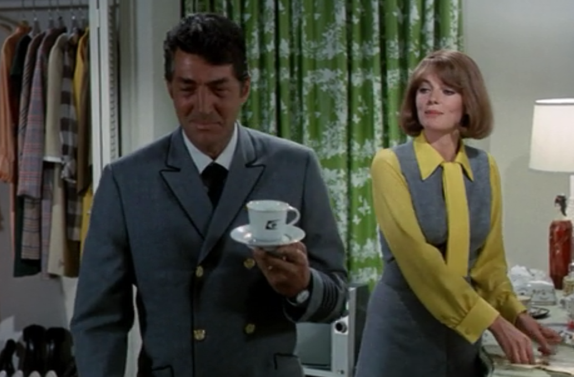
“COFFEE, TEA OR ME?” Deano makes time with his favorite stewardess — “You get me up to full throttle then throw me into reverse — you could damage my engine.”
Then we have “Outbreak” in 1995 starring Dustin Hoffman, Kevin Spacey and Rene Russo. And now “Contagion,” with Gwyneth Paltrow, Matt Damon, Kate Winslett and Jude Law (in a great role as the skeptic).
All are fine movies, but each one has a distinctly different story structure which reflects the changes that have been taking place in movie making. With “Airport,” they establish a little bit of tension at the opening with the snowy conditions, but then take lots and lots of time to set up all the various subplots of the plane that’s stuck on the runway, the tension between serious Burt Lancaster and the party boy Dean Martin, plus protestors demonstrating against the noise from the airport (with placards on a snowy night!). They have lots of fun until finally at 84 minutes the wife of the man who will eventually blow himself up (oops, spoiler, sorry) starts to tell them about the bomb he’s carrying, but then vanishes, and the tension is established — the plane is in jeopardy. Finally. With the movie already half over.
With “Outbreak,” a similar bit of initial tension is set up by the African village full of diseased mercenaries which is mysteriously bombed by the officials they thought were going to help them. But then we slip into the same mode of domestic storylines (with Dustin and Rene getting divorced) and kibutzing among the professionals (Kevin Spacey teases Dustin about his divorce). The tension steps up a bit with the need to make a trip to Africa in response to a disease outbreak. But the personal stakes don’t really set up until 23 minutes when Dustin discovers a tear in his containment suit. That’s when the story is finally engaged at a personal level.
Now jump to the present with “Contagion,” where zero time is wasted. The movie opens with Gwyneth Paltrow on a plane, looking and feeling ill. She’s a star. She’s sick already. There’s no time for fun and kibutzing. The story has already opened with a crisis. Later we’ll find out how she caught this disease. For now, she might as well be Pauline, strapped down on the railroad tracks with the train coming. Same thing we’ve converged on. Storytelling for the digital era. Same thing D.W. Griffiths scoffed at nearly 100 years ago. Plus notice the total length of the movies. Audiences used to be able to sit through more than two hours of disaster. Now it’s down to just over an hour and a half..
Not that there’s anything wrong with it. Just don’t be surprised at the limited shelf life of what’s being made today.
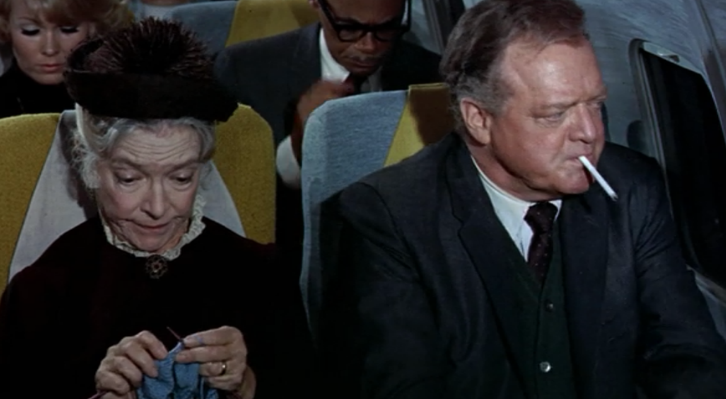
WERE WE REALLY ONCE THIS STUPID? Kinda hard to believe in retrospect — that you used to be able to strike matches on a plane to light your cigarette — until a few planes burned up with all their passengers. Amazing how slow the learning process is sometimes. This is the little old lady that Barbara Billingsley parodied in “Airplane,” when she said, “Excuse me, stewardess, I speak jive.”
#156) Read My Book Backwards, Please
September 29th, 2011
I’d like a Mulligan on the order of the chapters
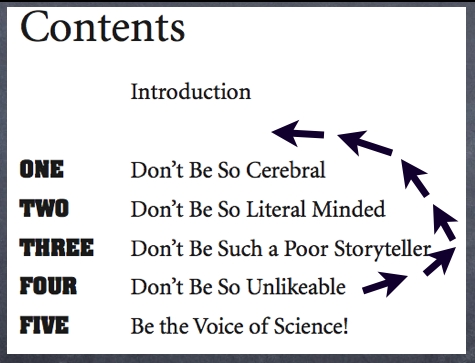
I’ve come to realize the logical flow of the four core chapters of my book, “Don’t Be Such a Scientist,” actually work best in reverse order.
mulligan
4, 3, 2, 1, BLAST OFF!
If you’re as lousy of a golfer as I am then you’re familiar with the age old tradition that allows you to hit your first drive into the woods, shout, “Mulligan!” to your partners, then start things over again. I’m beginning to think I’d like the same thing with the order of chapters in my book.
As I’ve given lots of talks on it, I’ve come to realize that the best way to put the contents of the book to work is to actually start with the last of the 4 core chapters first then work backwards.
START WITH LIKEABILITY
The fourth chapter is about likeability and unlikeability — or more specifically about finding the right common ground/messenger with your audience. I didn’t write this in the book, but what I say these days is, “It’s as simple as this — people listen to voices they like, they don’t listen to voices they don’t like.” Just like music. You can write beautiful lyrics, but if you pick a horrible singer to perform it, no one will ever even get to the content of your lyrics. As Malcolm Gladwell made clear in his brilliant book, “Blink”, it all happens very, very quickly. People hate the voice and disconnect in just a few seconds. And everything is over with.
How do you create a likeable voice? That leads to the third chapter which is about storytelling. More than 85% of the world’s population get their daily values and norms from the stories they learn from their religions. It’s still the most powerful means of mass communication. People love stories, so tell a good story (with the right voice) and they will listen.
How do you tell a good story? You need to be less literal minded, which is the contents of the second chapter.
And how do you become less literal minded? You have to come down out of your head to use emotion and humor. Which is the contents of the first chapter.
All of which is a more practical and useful flow of the information than the way in which is it laid out. So if you plan to use the book in a class or workshop, I strongly recommend you give thought to this.
And by the way, all of this falls under the subject of “story development” — as in developing the story of the book. I had about 30 years of incubation behind the writing of the book, going all the way back to 1974 when I first started working with scientists as a college dropout and marveling at the way they talk and think. And yet, clearly that still wasn’t enough time to get the story exactly right.
I don’t have any regrets on anything in the book, but if I were to write it again today I’d put those four core chapters in this reverse order. It just has taken me a couple of years of speaking to realize this.
Bottom Line: It takes A LOT of time to tell a good story with the most logical sequence of events. I’ve just figured this one out, two years after publication.
#155) My Talk on a Piece of Paper (Visually Recorded)
September 27th, 2011
The VERY talented Claire Bronson of c2bDesign “visually recorded” my talk last week in Portland to the International Society of Sustainability Professionals. You can click on the photo for a full-res version of the drawing.
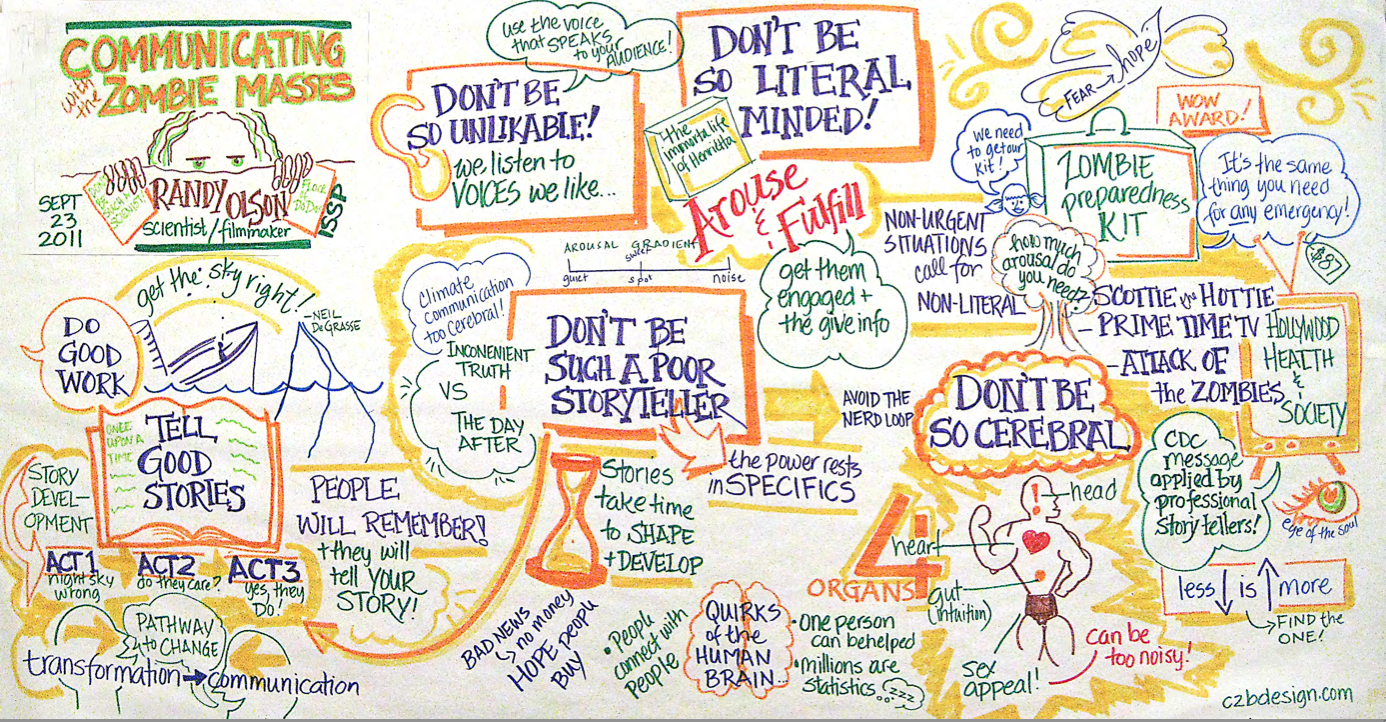
This is my brain on paper. While I gave my talk last Friday in Portland at the International Society of Sustainability Professionals, they had Claire Bronson off to the side performing live, drawing/writing. This is the “visual recording” of everything I said. You can see more of her excellent work here.
mind drawing
CONCISION
This is so cool I’m not going to muck it up with a bunch of my drivel. The thing speaks for itself!
#154) When Good Things Happen to Good People: Zombie Preparedness and Dot Earth
September 16th, 2011
I cannot say enough good things about the CDC’s Zombie Preparedness Campaign, and now it’s won a “WOW!” Award for P.R. And equally deserving is Andy Revkin of the big award he won for his Dot Earth blog. These are things I love.
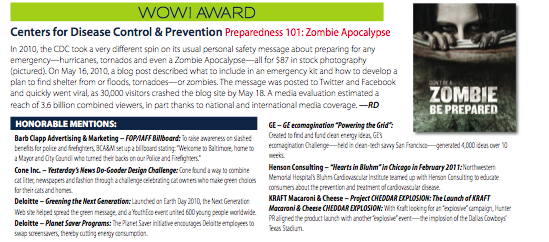
There could be no more appropriately named award for the CDC’s Zombie Disaster Preparedness campaign than the “WOW!” award. Indeed. Wow!
zombies eat brains
ZOMBIES KICK DISASTER ASS
I’m about raved-out on this topic. I don’t know how much higher of a thumbs up I could give it. I was at CDC again this week doing another communications workshop (my 4th in the past year — they are such a great group of folks there). The same day, Dave Daigle and his colleagues who co-created the amazing Zombie Preparedness campaign were in NYC for the Platinum P.R. Awards where they won 2 of the 5 categories for which they were nominated.
I already gave the detailed account of why I feel this is a textbook case study in how NON-LITERAL communication can create revolutionary impacts. The people involved with communicating about climate change absolutely must take heed. The subject of “disaster preparedness” had become one of those topics at CDC where the prevailing attitude said, “you just can’t get people interested in disaster preparedness when there’s no disaster.”
These folks proved that sort of malaise to be 100% incorrect. So for all the climate clods who whine that, “you just can’t get people interested in a disaster that’s 50 years away,” I say, WRONG, WRONG, WRONG.
You just need to be creative. Which is something that hasn’t happened yet in the climate community, due to the staid, cautious, narrow, stiffling, politically correct attitudes that prevail at the top. No wonder a billion bucks was squandered over the past decade.
DOT EARTH GETS DESERVED RECOGNITION
Also in the winners circle this week is Andy Revkin with his Dot Earth blog at the NY Times. He became the first person to win for a second time the Communications Award given jointly by NAS, NAE and the Institute of Medicine.
He is simply the best voice out there on the subject of climate. If there’s anyone at all close to the genuine idea of “fair and balanced,” surely it is he. And he has the battle scars to prove it — routinely taking beatings in equal measures from the far right and the far left.
But most importantly, he is a true conversation leader with his blog — using it more often than not as a forum for his readers to talk amongst themselves.
Congratulations, Andy. So truly deserved.
#154) The Climate Community is far behind Public Health when it comes to Communication
September 9th, 2011
There are so many examples. Here’s one which matches the basic recipe of my book — create a likeable voice by telling effective stories, producing a less literal mode of communication that ends up being effective because it is less cerebral. It’s really not that hard — all you have to do is just break the Nerd Loop.

nerd loop
Television shows like Gray’s Anatomy, Private Practice, and even Sesame Street end up being very likeable tellers of stories that, thanks in part to the Hollywood, Health and Society project end up including accurate public health information from the Centers for Disease Control. The result of this is a form of communication that is non-literal (i.e. NOT bonking people over the head with the facts) and less cerebral, resulting in more effective broad communication. Now if only the massively cerebral climate community can figure out such things.
nerd loop
BREAKING THE NERD LOOP
Earlier this year Dave Roberts of Grist interviewed Sandra de Castro Buffington about Hollywood, Health and Society — a project that has existed for about a decade in the Norman Lear Center for Entertainment Studies at the U.S.C. Annenberg School of Communication. I’ve gotten to know Sandra and the project over the past year by working with her conducting communications workshops at the Centers for Disease Control in Atlanta.
The HHS project embodies pretty much ALL of the basic principles of my book — it creates a likeable voice (ch. 4), through the effective telling of stories (ch. 3), which is a less literal means of communication (ch. 2) that is less cerebral and thus reaches the mass audience (ch. 1). And just to put the icing on the cake, each year they hand out their Sentinel Awards to the television shows that have done the most effective job.
Why isn’t the climate community engaged in this? Maybe they are getting ready to conduct a poll to find out how many Americans would like to see a project in which a likeable climate voice is created. (this is a lot like the argument I got into once when I said that PBS doesn’t know how to produce comedy, and a guy replied, “Yeah, but I once saw a documentary ABOUT comedy on PBS”).
#153) Let’s Kickstart “Sizzle: The Play” in Chicago
September 6th, 2011
They’re young, they’re eager, and they’re very cool — who better to support in this crazy world???
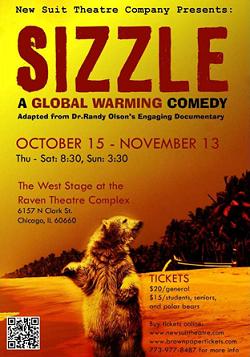
COMING TO CHICAGO ON OCTOBER 15: SIZZLE THE PLAY!
sizzle
It’s been over a year in the making, but the time is now rapidly approaching for the opening of the stage version of my movie, “Sizzle: A Global Warming Comedy.” The New Suit Theater Company in Chicago is putting on the production. They could use YOUR help in their Kickstarter fundraising drive. I just gave them a substantial donation.
If you’re thinking, “How can I do something meaningful,” in the struggle to communicate global warming to the general public, this is a perfect opportunity. This is a VERY creative and “outside the system” effort they are putting together. It’s a group of college aged folks who want to engage in an important issue in a creative way.
So make a statement for originality by going to their KICKSTARTER PAGE BY CLICKING HERE and give ’em a few bucks. They’re on to something very cool.
#152) Q: What Do You Get When You Avoid the Lower Organs?
A: NY Times Videos
September 2nd, 2011
If you have a powerful brand, you can afford to make a video without sex, emotion and only the driest and most sparse allowance of humor.
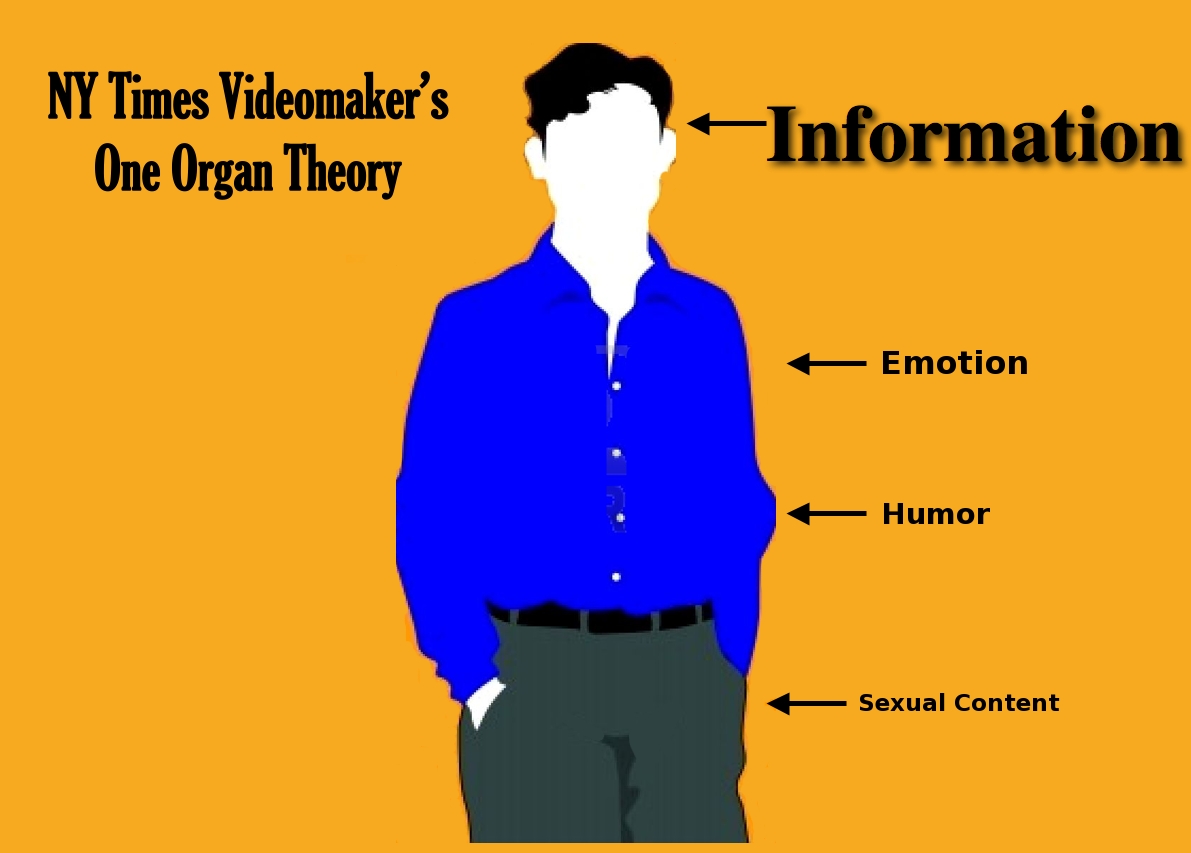
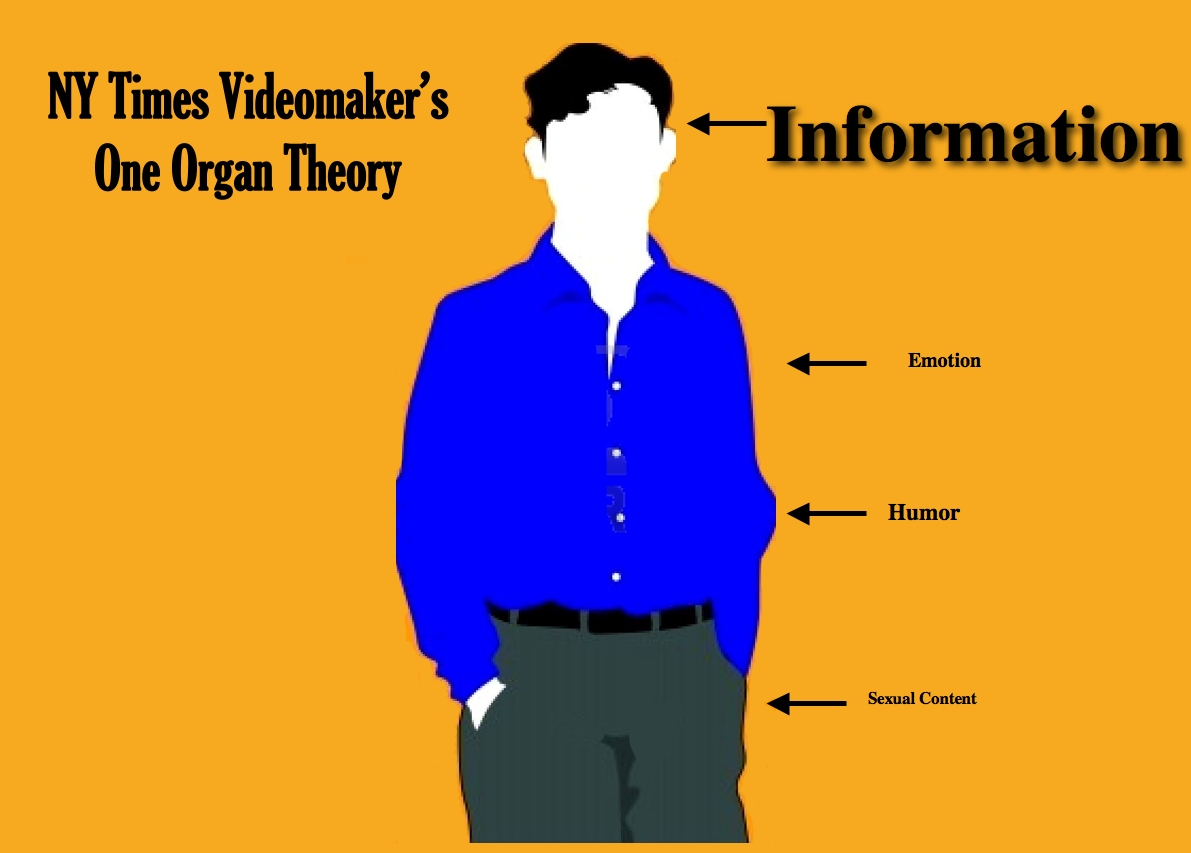
HOW TO MAKE A NY TIMES VIDEO. Watch the videos on blogs of the NY Times and you’ll see a very specific style that has been crafted to capture the staid voice of the esteemed newspaper. You won’t find anything from below the belt, only the driest of humor, and pretty much of a taboo on reaching for heartstrings. Such is the recipe for keeping things classy and dignified. But also, sometimes not that exciting.
The once proud and mighty NY Times (which of course I still swear by) was forced a few years ago to enter the blogosphere to stay alive. Then to give a little juice to their blogs, they began producing videos. Which are great. Don’t get me wrong. But if you look at the style of the videos… well, it’s kinda funny. And also kinda telling.
Andy Revkin periodically has their sort of almost branded style of videos on his wonderful environmental blog, Dot Earth. Now here’s a great article yesterday about Gregor Hodgson’s Reef Check project getting a start in the Caribbean nation that probably most needs what they have to offer given the depleted fish resources of Haiti. (it’s an excellent article AND nice video).
very very
KEEP IT CEREBRAL, MATE
So they seem to have developed their own unique style of videos that emulate the staid voice of the long serving “All The News That’s Fit to Print” brand. The videos are deliberately slow, somewhat ambling at times, very descriptive, with a narrator who probably has electrodes attached to sensitive body parts to make sure that he doesn’t come down out of his head into the lower organs — I’m guessing they’d give him a small shock for any emotion, a huge jolt for anything approaching sexual content or broad comedy, but apparently there’s a bypass for small, dry bits of occasional humor.
It’s just funny. The exception that proves the rule of the 4 Organs Theory. If you have a powerful brand name (as they do) you can afford to be dry, borderline dull, and always taken seriously. For NY Times videos, the proper approach is to NOT come down out of your head into the lower organs.
#151) Announcing a new website: www.SaltTheMovie.org
August 25th, 2011
It’s a simple film, 20 years later, but it still has a big heart. Now you can view it for free.
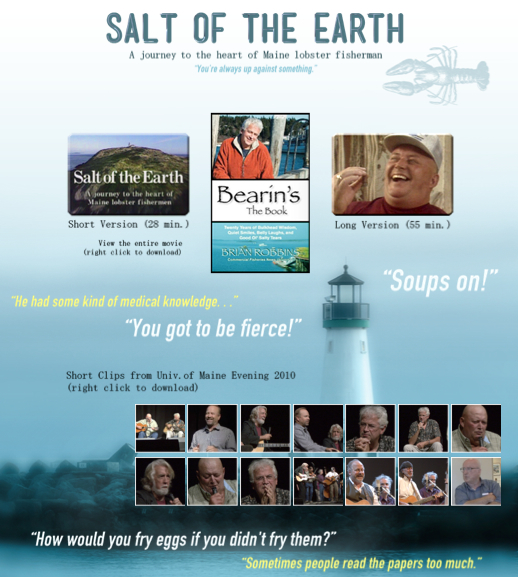
It only took us 8 months to assemble, but here it finally is, our new website presenting both the entire movie “Salt of the Earth: A Journey to the Heart of Maine Lobster Fisherman,” (you can now view it for FREE!) as well as 14 short video clips from our celebration evening at the University of Maine last fall. In twenty years of making films, I think this is the project I’m most passionate about. We made the film in 1991 but gave it new life last September in a tribute event at the University of Maine. Now we’ve posted the entire movie — both the short version (28 minutes) and the long version (55 minutes) for viewing on this new website, along with 14 short clips (2 to 4 minutes each) from the event.
It was an amazing evening that brought together two very different crowds with members of the fishing community mixing with the university faculty and students. Here’s to the Robbins brothers!