#41) Where’s the oil spill public protests and demonstrations? I second the questions of David Roberts of The Grist.
May 31st, 2010
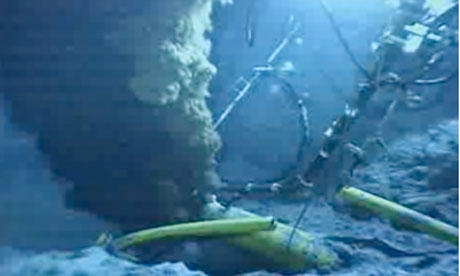
"There's your industry, going to pieces"
I generally don’t use this website as a typical “blog” (meaning a place for daily examinations of things in the news). Usually the posts are focused on one theme — storytelling in the world of science. But the gulf oil spill has become a massive story of it’s own, and I’ve reached the point where I find myself asking this one question every day — where are the PHYSICAL protests? Where are the people in the streets, expressing their outrage?
In my book I tried to offer specific suggestions on how to communicate science (and other technical topics) more effectively to broader audiences, starting with the titles of the four main chapters. In addition to the book I’ve tried at university visits and workshops to provide further suggestions and advice to people seeking to reach broader audiences with their scientific content. In this essay I’ll offer a little more of that.
Wanna grab the interest of strangers? Try telling a good story.
#39) “Information Pack Rats” and “Scottie the Hottie”
May 24th, 2010
It’s time to revisit “arouse and fulfill,” which is the simple couplet in chapter 2 of my book. We’ll do it in reverse order.

INFORMATION PACK RAT: Is this what your Powerpoint presentation feels like?
This Week on the Benshi: In Production (on hiatus)
May 17th, 2010
This week we (Ty, Ryan and myself) are employed in the service of Deloitte Touche Tohmatsu for whom we have written, and I shall be directing, a 20 minute video that TELLS A STORY which brings to life the decision-making workshops they conduct. It’s a project that arose in part from the book for which they are fans. On Wednesday and Thursday we’re filming a scene with five comic actors which provides the core of the film (and is fun!).
Tune in next Monday when the dust clears and we can see what we learned.
#38) The Syracuse Sizzle Discussion with Marc Morano, Ruth Yanai, Mark Meisner, and Randy Olson
May 13th, 2010
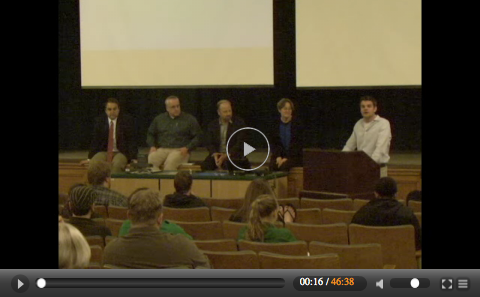
THE SYRACUSE PANEL DISCUSSION: Highlights include hearing Marc Morano explain why he wears make up, stating that he is not now nor ever been a card-carrying member of any environmental group, and hearing a graduate student at the end take off on the sort of lecture from an audience member that is the bane of every moderator. WARNING: the microphone they put on me was bad news (distorting) so you may want to lower the volume when I talk (sorry).
Q: How many Ph.D.’s does it take to communicate effectively their outrage over attacks on climate science?
A: Apparently more than 255.
On Friday, Science Magazine published a letter from 255 scientists complaining about the attacks on their credibility, but they accompanied the letter with a faked photo of a polar bear on an ice floe. A detailed description of the incident has been given by Andy Revkin on his blog Dot Earth.
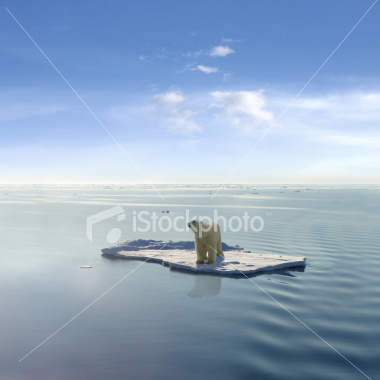
YES WE CAN (be made fools of). On Friday 255 scientists published a letter in Science Magazine that was accompanied by this photo from iStockphoto.
#36) Science: Who Cares? (Why we need the humanities)
May 6th, 2010
This is an essay that will irritate the literal minded thinkers, but it’s the cold truth about science communication. It’s also about a great article from Mark Slouka in Harpers where a humanities professor beats up on both science and his humanities colleagues.
THE MISTAKE OF JOY
A decade ago I was part of a discussion among professors at U.S.C. from a variety of science disciplines talking about the mass communication of science. One of the professors said, “I remember one of my higher level math textbooks in college — in the Preface the author opened by saying, ‘Who among us hasn’t at one time or another marveled at the sheer beauty of the prime numbers?'”
Well. Can I be the first to raise my hand? I can’t say I recall ever having that moment of joy.
Therein lies the fundamental dilemma with so many scientists in getting them to accept the difficulty of arousing the general public’s interest in science. The average person doesn’t share your passion, your sense of wonder, your curiosity, or your fascination for things scientific. To most of them science is cold and alien. That’s not to say they can’t be drawn in. It just has to be done the right way. Starting off by saying, “Prime numbers!” might bring smiles and looks of excited expectation from math majors, but for most of the rest of humanity it’s a cue to duck and cover because here comes equations.
When you develop a passion for some aspect of science you tend to assume the rest of the world shares it. Or at least is open to the possibility, if only they were exposed properly to the topic. For my Ph.D. dissertation in marine biology, I studied slimy brown creatures that grow on the Great Barrier Reef of Australia which I affectionately nicknamed “turdballs” and always assumed that if only someone were to make a movie about them the rest of the world would understand why I found them so fascinating. Nobody did, and to this day there’s probably only about a handful of us on the planet who would even notice if they went extinct. I don’t think we’ll be seeing an IMAX film titled “Turdball Journey” any time soon.
Getting the public to share your enthusiasm is a challenge.
#35) Movie Review (sort of): “Monsters from the Id”
May 3rd, 2010
On Saturday I was on a panel discussion of a documentary titled, “Monsters from the Id.” It was organized by Jennifer Ouellette, head of the National Academy of Sciences Science and Entertainment Exchange — a program for which I am a huge fan. It was also part of the Los Angeles United Film Festival held at the Los Feliz theaters.
For the post-screening panel discussion, I was intellectually dwarfed by two superstar scientists — Kristin Baldwin who studies stem cells at Scripps Research Institute and Kevin Hand of JPL who is trying to figure out how big of fish we can expect to encounter on the planet Europa, the sixth moon of Jupiter, when we finally send people there. Both of them are extremely articulate and communicationally (a word?) adept.
#34) Climate Interactive Simulation and Climategate (“Right, this calls for immediate discussion”)
April 29th, 2010
M.I.T. CLIMATE INTERACTIVE
Last Thursday night I was on a panel discussion at M.I.T. for Earth Day about communicating science in today’s information-overloaded world. On the panel was John Sterman of M.I.T. Sloan School of Management whom I met last December when he was in Los Angeles giving a talk (somewhat incongruously at the biggest talent agency in Hollywood to a crowd of entertainment industry gadflies). I found his presentation shockingly interesting, so when he invited me on Thursday to take part in his Climate Interactive simulation exercise the next morning, I figured why not.
He’s part of a team called “Climate Interactive” — a consortium including M.I.T., the Sustainability Institute, and Ventana Systems — who have assembled a simulation model about the climate fate of the planet which is simple enough for people to take part in a role playing version that only takes a few hours, yet opens your eyes up to the dangerous dynamics now unfolding in our planetary atmospheric experiment. He was on our Earth Day panel at M.I.T. on Thursday evening and invited me to join his presentation of the role playing game the next morning at a workshop, which I did.
#33) This Is How You Do It: A Great Example of Science Videomaking from New Zealander Steve Ting
April 26th, 2010
I know what you’re thinking — you are DYING to see a video about … science camp. Right? More than any other subject in the world. You’re just thinking, “Damn, I need to see me one of them science camp promo films!”
Actually, if you think that’s the last topic in the world you want to see a video about then you have something in common with our editor, Ryan Mitchell, since that’s what he felt when I asked him to view this video about a science camp in New Zealand. And yet … Ryan became an instant fan. Same with Ty Carlisle. Same with me (“the Randy of the group” to draw on the anecdote in my book).
On this website you hear me critiquing the making of films and videos a lot, as well as in my book (a book with the word “DON’T” in the title of every main chapter!). So it’s fair to ask from time to time, “Hey smart guy, why don’t you show us a few examples of what a good video should look like.” Well, here you go — sent to me last week from Steve Ting, a 25 year old filmmaker in New Zealand. He put together this 5 minute video for a science camp for kids in Otago, New Zealand. Check it out.