#259) DEBATING MORANO: Why… oh, why?
January 24th, 2013
How long will this continue? The evolution folks figured this dynamic out a long time ago. What’s wrong with the climate crowd? Doesn’t everyone realize it’s a no win situation? Why do it? NONE of Morano’s opponents have ever been any good. Is the opportunity to be on TV just too hard to resist? And hasn’t anyone in the climate community heard of “The Gish Gallop“?
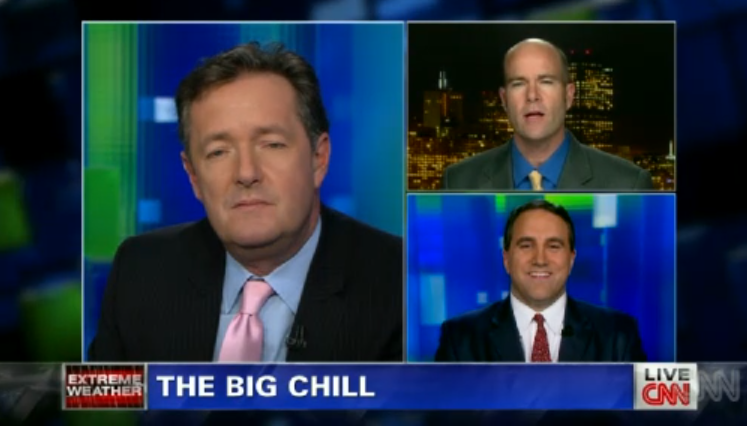
IF YOU CAN’T BEAT ‘EM, TRY TO DISCREDIT ‘EM?
space
IF YOU THINK THE GUY IS DISHONEST, THEN WHY DEBATE HIM?
In 2010, when I first started the Benshi, I did a lengthy interview with longtime climate skeptic Marc Morano. He was in my movie “Sizzle: A Global Warming Comedy,” in 2008 and we’ve remained friends, trading emails occasionally. I periodically enjoy his jabs at the environmental community, and he has a better grasp of the broader aspects of showmanship than most enviros. He also joined our post-screening panel discussion at Syracuse University a couple years ago.
As part of my interview with Marc I had a couple of professors of rhetoric, view all the clips present at the time of him “debating” climate folks — which was 4 then, but is probably about a dozen now. Both of them had the same observations. That it’s largely hopeless.
First off, rule number one for debating, which they both cited, is “attack the argument, not the man.” If you think your opponent is a dishonest liar then why debate him? Seriously. Why? Proper debate is meant to be a rational process of laying out arguments. Lying is irrational. If you show up for a fencing match and your opponent has a Bushmaster semi-automatic weapon are you going to ask the judge to disqualify him, or are you going to just call the entire thing off.
It’s the same deal — these climate folks are trying to convince the moderator Morano shouldn’t be listened to. In this latest case, this guy plays the oil companies card, which you can see Marc disagreeing with and I know that at least in the past that has not even been the case — he is not very well funded — it really is kind of a lie propagated by a lot of climate folks who do not know the facts but it makes for a good story. I know Marc. I have plenty of complaints about him and have criticized him firmly in my film and blog posts. But I also know he has not gotten wealthy from what he does, was not supported by the oil companies (at least last time I checked with him), and I really hate people who just run with that sort of dishonesty in trying to discredit opponents.
yup
EVOLUTIONISTS FIGURED OUT “THE GISH GALLOP” LONG AGO
If you want the best possible advice on how to deal with this problem of being “challenged to a debate,” you should probably consult Genie Scott, Director of the National Center for Science Education (which despite its name is not a government organization — it’s the sort of independent, highly motivated and highly focused organization the climate world needs).
She coined the term, “The Gish Gallop,” which is presented in great detail here. It’s what Morano skillfully does. And Genie has recommended not “debating” these types of folks.
So why do the climate folks continue to do so? And now Morano’s upped his game to Piers Morgan on CNN twice (he “debated” Bill Nye a few weeks ago who was just as bad as the others), who may not be your favorite host, but has a very high profile these days. Way to go, climate folks — way to help your opponent work his way up the ranks.
He’s already had an 8 page spread in Esquire magazine. How long until he’s on “60 Minutes”? And when that happens and everyone wonders how, a key part of the answer will be all these white knights who tried to ride into battle with him on TV talk shows. They have paved the way upwards.
plug
P.S. MY BROWN UNIVERSITY TALK FEB. 13
Next month I’m doing a week-long visit to Brown University. On Wednesday February 13 I’ll be giving a talk titled, “CLIMATE SKEPTICS: There here, they’re “queer,” get used to them” — with the “queer” part meaning out of the ordinary. The title is prompted by a run-in with a climate scientist last month who was STILL spouting the old 2006 line of, “we need to ignore them and they will go away.” That didn’t work. They ALREADY succeeded. Catch up with the times. There is no climate legislation today. The “ignore them” strategy failed. Move on.
#258) BARNACLE SEX: Apparently size isn’t everything after all
January 23rd, 2013
Barnacle boners have been close to my heart for over two decades. Now we all have to rethink our perception of how they are used by their owners.
HUNG LIKE A BARNACLE. This was where it all started for me in 1992. The vocal performance of Kansas City blues singer Baby Lee has stood the test of time.
space
THE COLD HARD TRUTH ABOUT BARNACLE MATING
Turns out size doesn’t really matter after all for some barnacle species. A little over 20 years ago I made this music video featuring Geoff Trager’s biomechanics work on barnacle feeding. The film had “legs” so to speak, being used over the ages in countless invertebrate zoology courses, as well as winning a bunch of awards at film festivals.
But now the shocking news — a paper this week in Science says there’s more to barnacle mating than just uncoiling your equipment and searching the neighborhood for a mate. Turns out some species are capable of “spermcasting”– ejaculating freely. I’m not going to comment further as it’s all downhill from here with the barnacle sex jokes.
#257) ROBERT TREAT PAINE: A Marine Biology Career to Dream Of
January 17th, 2013
He coined the term “keystone species.” I dedicated my book to him. Look how many great scientists he helped create. It’s a science career deserving of the greatest honor.
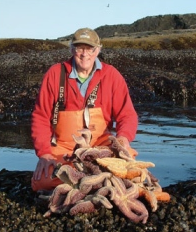
MASTER OF THE STARFISH. For over 50 years Bob Paine has studied the intertidal ecosystems of Tatoosh Island off the coast of the Olympic Penninsula in Washington. There is no one in the world like him.
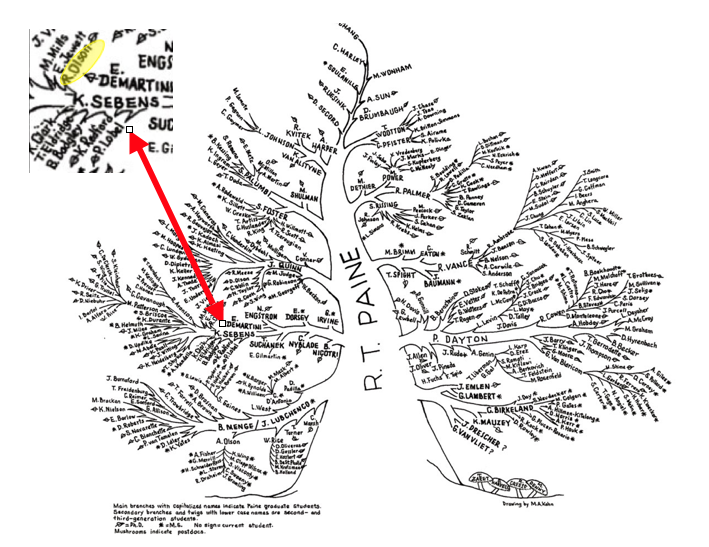 ALL IN THE FAMILY. Second branch up on the left is my Ph.D. advisor Ken Sebens. I was his first graduate student. Not sure I’m worthy of such amazing company. What a crowd.
space
THE DUDE MADE MARINE ECOLOGY FUN
Bob Paine is the best. I was lucky enough to be his field assistant for a summer, working on Tatoosh Island, when I was an undergraduate at University of Washington. Nature just published an article with his academic genealogy tree. He is turning 80 this spring. A truly amazing person.
As I said in the dedication of my book, he taught me not only ocean science, he made it fun. He really did. He’s a tremendous storyteller and thus part of the source of my obsession with the power and importance of story.
A truly great storyteller who is also a member of the National Academy of Sciences. Now THAT is a career for ALL scientists to aspire to.
#256) TRUST and LIKEABILITY: My “Options Politique” Article
January 14th, 2013
After running the U.B.C. Videomaking Workshop last September I was asked to write an essay for the Canadian magazine Options Politique. In it, I talk about the importance of storytelling to the Obama election (one small story in a TV commercial may have been the deciding factor) and how politicians live and breathe the importance of trust and likeability, while environmentalists and scientists still just don’t quite get it.
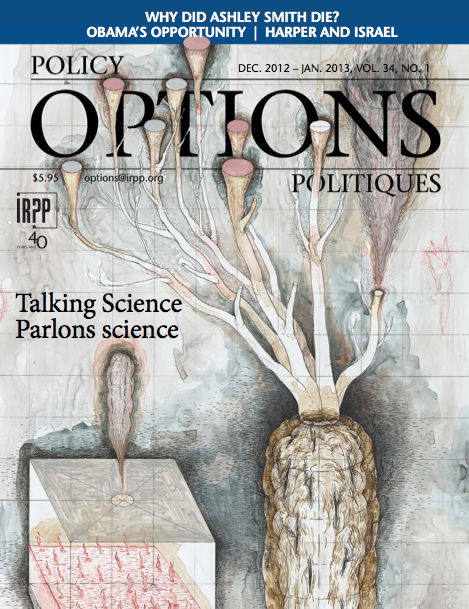
Wanna hear me parlons some science? Here’s an article I just wrote on the subject.
space
TRUST ME AND LIKE ME (PLEASE)
So I assume you know of the distinguished journal Options Politiques. Yes? You do? Cool, then can you tell me about it?
Sorry. That’s terrible. I just really had never heard of it when they asked me to write this essay last month, but they did a nice job of pulling what I wrote together with a cool layout.
No need for a bunch of background on this one. It’s about trust and likeability. And not much more. Wanna know how to win over the American public on climate change? Create a voice that they trust AND like. That hasn’t happened yet.
Here’s what I have to say on the subject in detail.
#255) TONE MATTERS: Stupid, stupid science bloggers
January 5th, 2013
Similar to Dominique Brossard (quoted in this article on the anti-science literacy side of science blog comments) I am not the least bit surprised by the finding that the comments sections in blogs damages science literacy. What do you expect from so much negativity? It’s why I created The Benshi as an “on-line journal” 3 years ago with no comments.
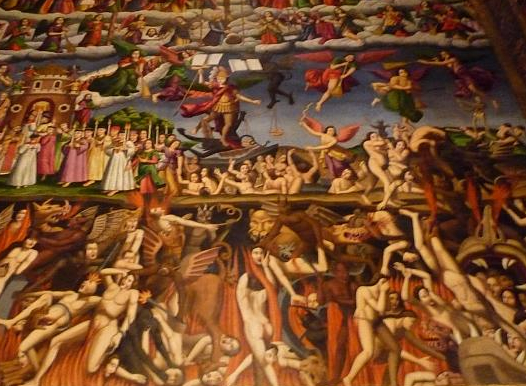
HEAVEN AND HELL IN THE SCIENCE WORLD. What do you expect when you create these on-line venues for unlimited negativity?
baby
HEAVEN: MY ORIGINAL SCIENCE EXPERIENCES
In my life I have know two science worlds.
The first I knew for 32 years: 1974 to 2006. It was made up of the incredibly fascinating, fun, intriguing and adventurous science people who drew me into their profession at age 19, then caused me to head to Hollywood at age 38, inspired to tell the stories of their lives. Yes, I used to bitch about the headaches of science funding, but I met so many wonderful people and I’ve tried to pay my respects to some of the best through my media work, like Stephen Jay Gould (I honored him in “Flock of Dodos“), Bob Paine (I dedicated my book to him), Ruth Turner/Colleen Cavanaugh/Cindy Van Dover (I made a video about these three women who worked in the deep sea submersible R.V. Alvin), and Jeremy Jackson (I made videos about him for Shifting Baselines). I left the science world with this warm, glowing reverence and fondness for the people I met.
And then in 2006 that all changed.
wow
HELL: THE BLOGOSPHERE
Suddenly this thing called blogging came along, suddenly all these “science blogs” appeared, and suddenly there were all these writhing, thrashing, moaning, miserable voices emerging from the world of science that I had never, ever heard during my career as a scientist. The voices arose somewhat from bloggers, but much, much worse from the people posting anonymous comments on the blog posts of the bloggers.
Bloggers were eventually stunned by the hatefulness and by 2007 there were discussions about whether to do anything (to his credit my favorite blogger Andy Revkin spent a lot of time wrestling with this dilemma and does at least limit foul language). But some supposedly brave souls felt it their duty to the first amendment to not “censor” the comments on the blogs and just let the animals run wild.
Now Dominique Brossard and Dietram Scheufele have published a study showing what everyone could have guessed — that if you give people a factual article accompanied by a bunch of horrible comments they walk away with a different experience than just reading the article by itself. And that overall experience is not a good thing for science. Nice work, dummies. Way to lower science literacy.
In 2007 I really couldn’t believe the sheer tone of negativity in the science blogs. And I wondered, “Don’t the leaders of the science world realize what this does to your profession?”
The answer to that question, as I’ve learned, isn’t really yes or no, it’s more like “Question Not Relevant.” Meaning that there is no real leadership to the science world, so there is no one to take much interest or concern. I’ve learned, particularly through my involvement in recent years in some committees from major science organizations, that the whole profession is run by committees with very limited leadership. Basically no one is guiding the ship, it’s all set up with assumption the ship will guide itself.
run
WHY SHOULD SCIENCE BE ANY DIFFERENT?
This is the obvious first reply — “Well, every other field has its blogs and they don’t censor anything so why should science?” Because the profession values honesty and accuracy more than any other profession. With honesty and accuracy goes a certain sort of dignity. If the profession loses it’s dignity then a basic message is sent out that honesty and accuracy no longer really matter. And guess what — there’s an awful lot of science scandals these days. Yet another big surprise?
Anyhow, I just want to say thank you to Dominique Brossard and Dietram Scheufele for publishing this study. It is important. Communication is important. The TONE of communication is important. It takes leadership to maintain dignity. Running blogs with comments sections filled with the wailing of hyenas shows no leadership whatsoever.
#254) HAPPY NEW YEAR: Who will arouse the masses in 2013?
January 3rd, 2013
British enviro-pundit George Monbiot starts the new year with a note of reality — that most of the world doesn’t share your environmental concerns. Furthermore, 2012 was “the worst year for the environment in memory.” He points to the “great collective shrug” at the Rio +20 Summit last June and the limpness of the climate thing in Doha. So true. Which is why “The War on Boredom” needs to be made an urgent priority for 2013. The opposite of boredom is arousal. The question to ask is, “Who will arouse the masses in 2013?”
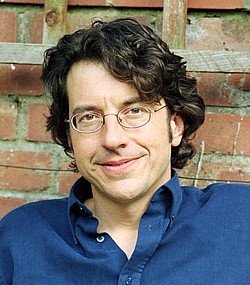
ENVIRO WISENHEIMER. I’m a fan of George Monbiot. His essays kick ass. He does this old fashioned thing called “speaking the truth.”
PROBLEM: NOBODY CARES
A little over a year ago I ran a communications workshop with 22 environmental activists in Los Angeles which I began by telling them that nobody cares about what they care about. You may love the sight of a mountain lion in the wild enough to dedicate your life to protecting it, but statistically speaking, almost nobody else cares enough to help.
That evening we went for beers and several of them said I started the day by stunning them with that perspective. Their entire livelihood is based on the assumption that everyone cares about nature. They found it disorienting to hear that might not be true.
George Monbiot, who is the kind of dedicated activist that most people only dream of being, published a GREAT end of the year essay in The Guardian titled, “2012: the year we did our best to abandon the natural world.” I love it. I love people who are brave enough to just speak the truth, plain, flat and simple. I guess it’s the scientist in me that still values the truth.
boredom
TARGET: THE WAR ON BOREDOM
The problem, worse than ever, is this: the shit is boring. Plain and simple. That’s what produces a “collective shrug” — a complete and utter sense of boredom.
For 2013 I will be trying my best to combat the war on boredom by both “telling” and “showing.” On the “telling” front I’ll be continuing our S Team workshops with Dorie Barton and Brian Palermo. These days, they are my two communications heroes. I have more faith in them as warriors in “The War on Boredom” than anyone else. On the “showing” front I have one new movie coming out this year, and will be filming at least one, and possibly two more. They will be exercises in storytelling as a means of fighting the stench of boredom.
listen to meh
WHEN THEY’RE AROUSED THEY’RE LISTENING
Lastly, here’s my catch phrase for 2013. It’s a combination of Brian’s wonderful line about improv comedy — he says, “When they’re laughing, they’re listening” — and the basic tenet of my book of, “arouse and fulfill.” If you combine the two, (knowing that people the world over like to be aroused) what you get is that, “when they’re aroused, they’re listening.” So here’s the real question …
Who will arouse the masses in 2013?
#253) CHARLES DURNING: Great War Hero, Great Actor, but Malmady Survivor?
December 26th, 2012
A few words of respect for Charles Durning who died on Monday at age 89. He was a great character actor, a tremendous military hero, and a really good guy (plus a Democrat) whom I got to spend a day with in 2004. But he leaves behind an interesting question: was he at the Malmedy Massacre?
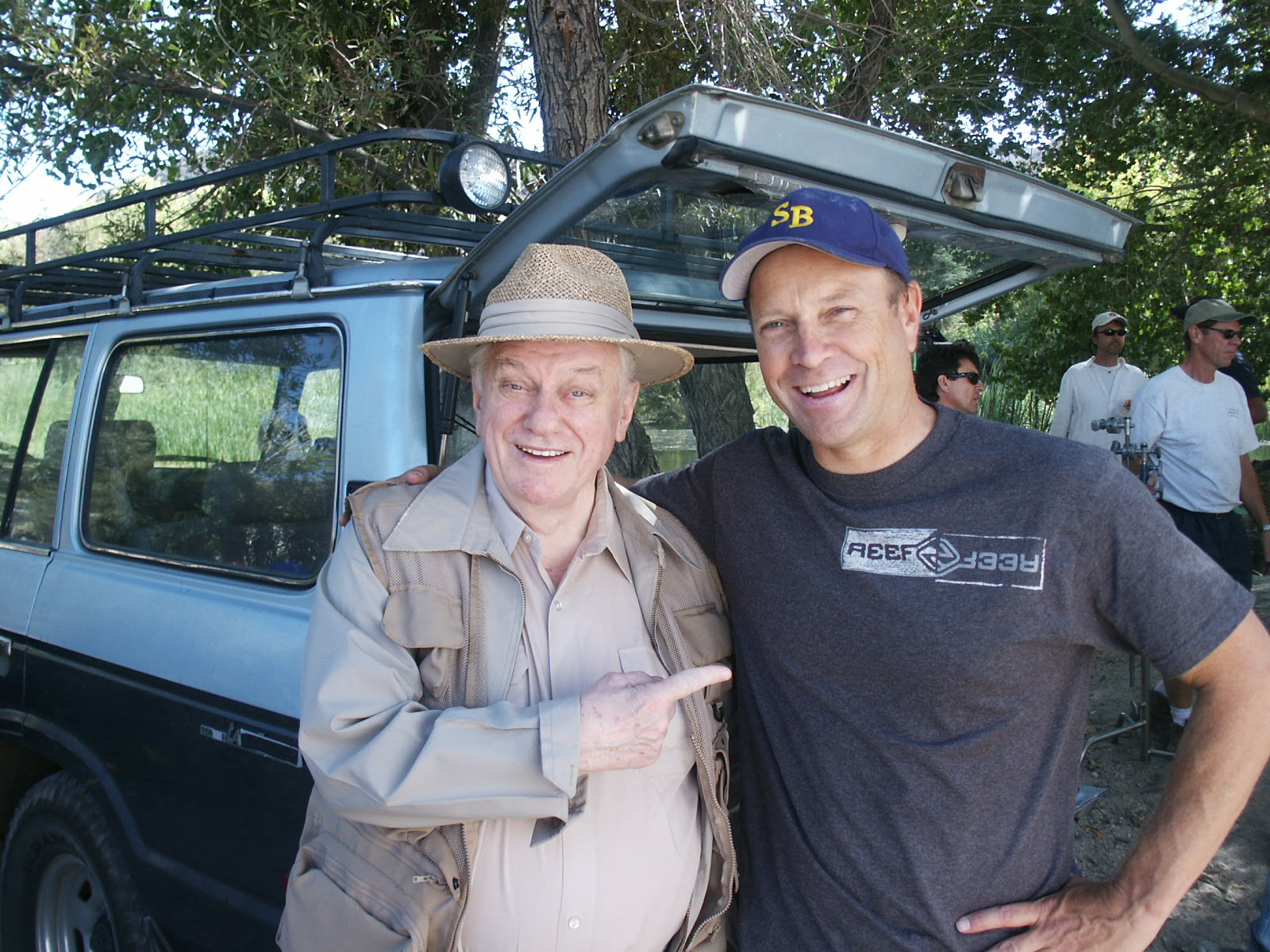
I got to direct a TV commercial for the Kerry Campaign in 2004 starring the late Charles Durning. More memorably, I had a great day hanging out talking World War II with him. There tends to be a correlation between the quality of character actors and how big of a character they are themselves. He was a great actor with a LOT of fascinating tales to tell.
tons even
A GREAT CHARACTER ACTOR
Hollywood is such a crazy thing. A guy goes and risks his life for his country, performs incredibly heroic feats in war, and when he finally passes away, the main thing he’s known for is play-acting movie characters ranging from a sketchy governor to a horny Nazi. Such is the life of Charles Durning.
In 2004 I was lucky enough to spend a day directing him in a television commercial for the Kerry campaign. It was an awesome day. There were a few border states where mercury pollution in popular waterways was a serious issue, so the environmental folks in the Kerry campaign were eager to associate him with the efforts to combat mercury pollution. My old buddy Dr. Steven Miller (who was my partner in the Shifting Baselines Ocean Media Project and would eventually be executive producer of “Flock of Dodos” as well as the current Lionfish PSA Campaign), quickly raised the funds for me to write and direct a commercial for the campaign.
Working through Hollywood contacts we heard that veteran character actor Charles Durning was a keen Democrat (even though his wife was a staunch Republican and literally tried to keep him from associating with us). He agreed to give us a day, I pulled together an amazing crew of industry veterans (including the very best cameraman I ever got the joy of working with — they were all Democrats willing to donate their time for the campaign), we found a location north of L.A., and within a couple days were out there filming.
The net result was a commercial that was okay. It didn’t tell a devastating story the way the Obama commercial that I discussed a few weeks ago did. But it was thought be of value in the areas where they knew the mercury issue was relevant. Also, we got Paul Newman to do the voiceover which was fun — I directed him over the phone — but he did his performance at the end of a recording session for the animated feature, “Cars,” and he was very old by then so most people didn’t even recognize his voice (which was a lesson to me in voice talent).
goodbye
BUT WAS DURNING AT MALMEDY?
The biggest joy of the experience was getting to spend the day chatting with Mr. Durning. He wasn’t just a run of the mill World War II veteran. He landed at D-Day, was in the Battle of the Bulge, and was part of the Malmady Massacre. At least that last bit is what he told me, in detail.
2004 was still pre-Wikipedia time, so I had little to go on when a friend told me to ask him about “Malmady.” But I did. And even though the obituaries now are saying he didn’t like to talk about his war experiences, he shared everything with me. Part of the reason he was willing to talk may have been because I told him some of my father’s war experiences from the Bataan Death March in the Philippines.
The Malmady Massacre was a horrific event in which the Germans, after the Battle of the Bulge, rounded up and executed 80 American POWs. Mr. Durning told me he was in that group, but he and six other guys hid behind trees then escaped.
According to Wikipedia, 43 men escaped. But interestingly, in the detailed Wikipedia discussion of Malmady, they conclude that Durning was not a part of the event. They are unable to identify his unit or any records of his being there, other than the French consul saying so in their 2008 presentation of the French Legion of Honor to him.
The Wikipedia discussion argues that because there is no documentation, and more importantly, because so many accounts of what happened at Malmady are “embellished and inaccurate,” that he should not be cited as a survivor of the incident.
silly
“THE STORY IS HISTORY”
I only know two things. First, no one doubts he was at D-Day and the Battle of the Bulge, but he also told me he was there at Malmady. He talked about how cold it was that day in the snow as they were hiding behind the trees. But second, last year I met with Gavan Daws who wrote the definitive book on Japanese Prisoners of War. He interviewed over 200 surviving P.O.W.’s. He told me he was fond of my father because he was, in his opinion, one of only a handful that he felt was actually telling the truth — most of the rest had either intentionally or unintentionally blown their stories up over the years into hugely embellished tales that contradicted each other and played loose with the facts.
I really found that shocking to hear. It leaves you nervous about listening to the tales of war veterans. Then when you read about the increased skepticism these days in the legal system of the value of “eye witness accounts” of crimes, you do kinda wonder. And then you go and do a documentary feature film about the Bataan Death March (as I did last year and will begin screening on Feb. 14 at Brown University) and you end up gaining your own appreciation for the fact that history is just some agreed upon set of stories. Nothing more. Incredibly subjective. Which is strange.
And then I flash back to Kathy Martin, the Kansas School Board Member in “Flock of Dodos,” who said she’s comfortable believing Washington was our first President because people were there to see that, but not comfortable believing fossils could be millions of years old because “nobody was actually alive that saw a lungfish crawl out of the water.” As if eye witness accounts were more credible than science. Sheesh. Crazy humans.
#252) Are Converted Climate Skeptics of Any Use?
December 18th, 2012
Good question. Once again, it’s about TRUST and LIKEABILITY. If the person seems like someone you wouldn’t trust or like, then no, they’re not helping anything. But that means you need to be a good judge of trust and likeability.
CREEPY IN, CREEPY OUT.
Weird
KAHNEMAN TO THE RESCUE
Yesterday some climate folks sent me this video asking my opinion. Is this woman’s testimony of any value? And what sort of criteria could you use to decide that?
My first instinct was to refer back to Nobel Laureate Daniel Kahneman’s concise and powerful assessment of communication in his talk to the NAS conference in May. He broke it down into three simple elements: evidence, trust, and likeability. His message was that all your evidence is of no value if people don’t trust and like you (which can also be reversed into the definition of a conman — someone with complete trust and likeability but no evidence).
In all the years I’ve spent interested in this communication stuff, that simple assessment from him is about the most useful. You need to carry it around and apply it to just about everyone to get an idea of their potential as a communicator. Do I trust this person? Do I like this person? And yes, I hate to tell you this, but the evidence element is fairly trivial. When you find an expert whom you trust and like, you don’t really need much evidence. Just think about doctors and financial advisors. How many people really need their doctor to provide the evidence justifying a prescription? Yes, maybe you’re critical about your doctors, but most people still aren’t. It’s how humans work.
This is the prime reason the “climate argument” made by scientists and environmentalists has been so unsuccessful. They have had this blind belief in the evidence, while failing to master the trust and likeability components. It’s what Kahneman was saying (you knuckleheads).
So the answer is a double “no” on the woman in this clip. Within FIVE SECONDS she comes across as weird with her quavering voice, overly-emotional (“Lady, it’s only a documentary about ice”), and lacking articulation (she doesn’t say ANYTHING specific about the movie — something that might help us understand why she’s on the verge of tears).
hot
A PERSUASIVE FLIPPER
Still, it seems like it could be persuasive to produce people who changed their opinion on climate change if they radiated these two traits of trust and likeability. One example of this, very much, was Michael Shermer, who wrote his great essay, “The Flipping Point,” in the 2006 Scientific American, in which he said he read four good books on global warming which changed him from climate skeptic to climate concerned.
He radiates trust and likeability. I interviewed him for my movie “Sizzle” and felt like he was such a nice and decent guy, I didn’t even want to include him with all the folks we played our little (harmless) trick on, so he didn’t make the final cut. Just look at any interview with him — he projects these two key qualities. It’s not something he does intentionally, he just comes across as someone you can trust and like. These tend to be natural traits in people.
More importantly when it comes to the climate issue, what you really need are voices like the guy in the Obama commercial that I discussed a couple weeks ago. There’s your basic working class dude that really does present a persona and voice that’s prone to be widely trusted and liked by the very sort of average folks you’d like to persuade about the importance of climate change.
So, yes, testimonials of people who have changed their mind on climate do have the potential to be powerful. But they have to have these two attributes of trust and likeability. You can’t just use a privileged New Englander who speaks with a Boston Brahmin accent and pronounces the word, “can’t” as “cahnt.” That just doesn’t work.
And now I’m flashing back to the crap workshop on “Communicating Climate Change” I attended last year where they were showing footage of the head of a major environmental group, and talking about what a tremendous spokesman and communicator he is. Ack. Don’t get me started. I had to walk out of the session. It’s about voices of trust and likeability. No CEO of a major environmental group has this for average Americans. You have to be tone deaf to think they do. Don’t let them be the spokespersons for this very important issue. You need average Americans. Time to call Central Casting.
#251) THE ‘S’ TEAM WORKSHOP: “Critical Storytelling” in Action
December 11th, 2012
Last week’s version of our S Team Workshop with the National Park Service produced another “wow” moment at the end. Storytelling needs a critical perpsective . That’s what we’re teaching.

DO YOU REALLY KNOW WHAT A STORY IS? This question is at the core of the S Team Workshop. It starts with gaining a clear, critical understanding of what is, and is not, “a story.” Here’s Brian reading the logline of “Star Wars” as Dorie leads the narrative structure part of the workshop last week with National Park Service.
space
WHAT IS (AND IS NOT) A STORY?
Last week we staged the third incarnation of the “S Team Storytelling Workshop” which I first assembled a little over a year ago. The team consists of myself as the bridge between Hollywood and the science/environmental world, Hollywood script analyst Dorie Barton as the “cerebral” element (narrative structure), and Groundling/improv instructor Brian Palermo as the “visceral” element (improv acting exercises). The detailed description of the workshop I’ve provided here.
The first iteration was last year in Los Angeles with 22 environmental activists. It was good, but we were just getting started. In August of this year, we ran the workshop with 22 staff of the Natural Resource Defense Council (NRDC) in San Francisco. That one ended with an eye-opening finale as the participants took in our notes on their stories, did a final rewrite, then ended the day with tight, punchy, powerful stories ready to put to work in presentations. We were as impressed as they were with the ground they covered in just one day.
The third, and best yet, version took place last week in Fort Collins, Colorado with two groups of 12 each from the National Park Service. This time we split the workshop into two days which added an extra element of allowing the first day’s material to sink in overnight. This one also ended with the participants having molded their stories from very crude first drafts to tight, efficient one minute presentations by the end. But there was something extra.
space
CREATING CRITICAL MONSTERS?
On the day after the workshops I met with a smaller group of their climate folks. At the start of our session I showed them a short climate video that several of them had seen before. One person said, “Oh, yeah, this film is great!” Just before I played it. But when it was over she changed her mind. “Actually, that wasn’t as good as I remember.” Then the others began chiming in with, “there was no story — just a bunch of expositional statements,” and, “it kind of lacked specifics,” and, “there was no clear theme,” and a bunch of other critical comments that came right out of the previous two days of critical thinking towards storytelling.
In some ways it sounds like kind of a bummer — that we taught everyone how to not enjoy films. But this is serious stuff. Narrative structure is incredibly important and little practiced. As I pointed out a couple weeks ago, the ENTIRE Presidential election outcome may have been determined by a few folks who had a good grasp of narrative dynamics. You can no longer afford to be naive on this stuff.
So I know this sounds like a big advertisement, which maybe it is. The fact is Dorie, Brian and I are all overbooked for next year and not looking for this sort of work (and have at least two more bookings for this workshop coming together). But the workshop is a huge amount of fun for all of us. We actually LIKE working as a team and meeting new folks, and when it’s helping good folks like the NRDC and the National Park Service it makes us feel like there’s an extra value.
The workshop is a dynamic entity that is still evolving as we go along. Each time the three of us work together we’re continuing to build on what we’ve learned so far. It’s a Hollywood-oriented approach to studying the way analytical people tell stories. It’s fascinating. You should get in touch if you think you might want to book the workshop for your group. You can write to us here: info@randyolsonproductions.com
Our next group outing will be at the Aquatic Science Meeting in New Orleans, Feb. 17-19, where the three of us will be doing both our S Factor Panel (presenting 10 short videos made by scientists) and a shortened version of our workshop. Hope to see you there!
#250) NY Times Decline Continues, as Predicted by EPIC 2014
December 3rd, 2012
In 2004 a short video about “the future of news” laid out a pathway that has proven to be chillingly accurate. The 8 minute piece ends with saying by 2014 the NY Times will have been relegated to being little more than, “a print-only newsletter for the elite and the elderly.” Another round of “buyouts” there, suggests the prediction remains on track.

EPIC 2014 predicted the merger of Google and Amazon into Googlezon, which of course hasn’t happened, but the Big Brother spirit of the internet continues unabated.
epic
THE FUTURE OF THE NEWS
This is a fitting topic for my 250th essay here. This will be short because I’m in Colorado all week running our S Team Storytelling Workshops with the National Park Service staff (then at Florida State next week doing the same).
I was deeply struck in 2005 when I first viewed the 8 minute EPIC 2014 video created by two producers as a critique of the news industry. I mentioned it in my book. It opens with an authoritative graphic saying it is a production of The Museum of Media History. As if such an institution exists. It took me a while to realize it doesn’t. Very clever.
I learned about it in late 2006 when Michael Hirschorn of The Atlantic ran a great article about how the producers debuted the piece at a gathering of top newspaper editors at the (real) Museum of Television and Radio in 2005. The article said the newspaper people, who had spent the previous few years horrified at the potential threats to the future of their institution, had finally developed the feeling that the worst was over — that newspapers and the internet had settled into a pathway of compatibility. Only to have this little video say nope, the future is actually worse than you feared.
At the time of Hirschorn’s 2006 article the NY Times had just announced plans to cut 1,000 jobs in the next two years. It’s 6 years later and the trend continues with today the NY Times announcing another round of downsizing.
It’s pretty ominous and true. Listen to the end of EPIC 2014 as they hit the “decline of intelligent media” nail on the head:
“At it’s best, edited for the savviest readers, EPIC is a summary of the world, deeper, broader and more nuanced than anything available before. But at it’s worst, and for too many, EPIC is merely a collection of trivia, much of it untrue, all of it narrow, shallow and sensational. But EPIC is what we wanted. It is what we chose.”
It’s that last line that is so haunting — it is what we wanted and what we chose. Truly.