#269) Botched Messaging for Shark Conservation
March 15th, 2013
How do you have a vastly unsustainable 100 million sharks a year being slaughtered, yet USA Today telling its readers “it’s all good”? To the uninformed reader, this headline says one simple thing — sharks just got “global protection.” Plain and simple. And not true.
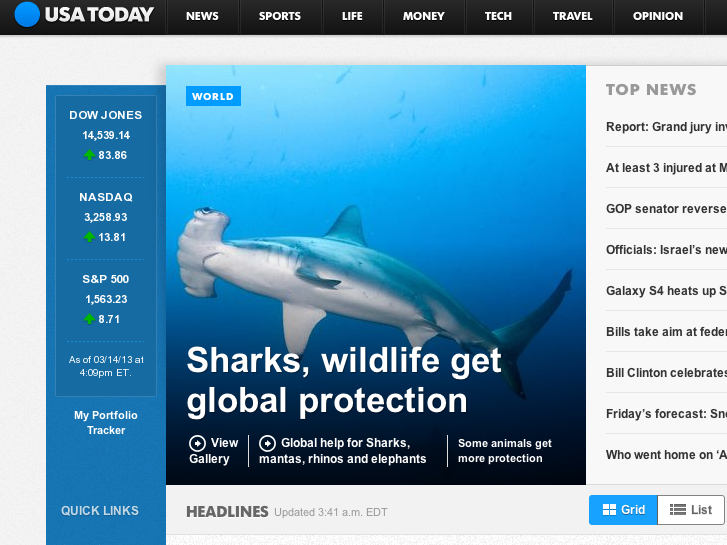
DON’T WORRY, BE HAPPY! Nice job with the messaging. Here’s the nation’s second largest newspaper sending out the word this morning that sharks are all set now as they “get global protection.” Whew. I guess there’s no problem with them after all. Time to close up all the major shark conservation groups and move on to protecting barnacles.
space
MISSION ACCOMPLISHED?
I sure hope somebody in the shark conservation world fell out of their chair when they saw this on the front page of USA Today, the nation’s second largest newspaper. It says sharks “get global protection.” Who cares about whatever the reality is (namely that I was in Fiji two months ago and saw the shark slaughter problem with my own eyes, its out of control and being reported at 100 million a year), the perception projected from this headline is that … well, sharks “get global protection.”
The article accompanying the headline fills in the details — that CITES voted to protect 5 species somewhere, somehow, while the article even mentions the 100 million sharks harvested annually. The proper headline should be “Sharks Still Getting Screwed.” And btw, in today’s rapid world, headlines are about all that matter for broad communication.
How can there be all the MASSIVE conservation groups with the massive budgets and massive teams of communications “experts,” yet this is what appears in the nation’s second largest newspaper? It’s the sort of bungling of conservation communication that has gone on for over a decade. Yes, I know what the communications people will say, “It’s the media’s fault, we can’t help it.” You won’t hear Hollywood publicists saying that when the headlines come out about their clients. The good ones know how to make sure the headlines match what their client wants. There are ways to achieve that, but only if you’re good at it.
Even the Japan Times will tell you sharks are in “freefall.”
#268) A GREAT “Night Skies” Video from the National Park Service
March 12th, 2013
An excellent collaboration between three organizations (National Park Service, Global Explorers, Madhouse) serves as a model for broad communication of an environmental issue.
THE DAY THE LIGHTS WENT OUT. A great video collaboration of three groups.
space
REACHING FOR THE SKY, WHILE REACHING INSIDE
Last December, Dorie Barton, Brian Palermo and I conducted our storytelling workshop with the wonderful folks of the National Park Service in Fort Collins, Colorado. A couple months later, one of them sent us the above video they had just commissioned, seeking our opinion (hoping that we would approve). All three of us were thoroughly impressed, telling them it is the very embodiment of all that we teach in our workshop.
What a great piece of work. Which makes twice now that the folks we’ve run the workshop with have produced excellent work — the other being the NRDC folks with their couch video that we raved about last month (we did a workshop with them last August). Let me now extoll the virtues of this video.
STORY DEVELOPMENT – Each of the three groups played their respective roles. The National Park Service folks decided they wanted a short video that kids would connect with about the value of night skies. They partnered with the Global Explorers, who work with groups of kids and know the audience well. They in turn contacted Madhouse Productions in Toledo, Ohio who came up with the great little story of the kid and the night skies. I spoke with Rob Seiffert of Madhouse who directed the piece. He said their entire company threw their hearts into the production of the film. It really shows.
NARRATIVE – What a great little story. It’s set in total “storytelling mode” which is just about the broadest possible voice. It actually feels a lot like Martin Scorcese’s “Hugo” from a couple years ago. It’s a simple story, yet there’s a few twists and turns along the way.
Notice the story conforms completely to the “And, But, Therefore” template we talk about in the workshop. The story begins at 0:10 with a number of expositional facts: a “man” bought a house AND began painting the night sky AND his paintings sold like hot cakes BUT (right at 0:50) the stars disappeared as the man lost the night. They hit a second BUT moment at 1:05 with “But with every flipped switch …” which just elaborates on the first one. Then at 1:25 the narrator says, “Til one day he went out …” which is pretty much the same as the THEREFORE element — it’s the action he took in response to the circumstances.
In a single sentence you could restate this story as, “A man painted the night sky AND did well selling his paintings BUT then one day over-development ruined the night skies THEREFORE he figured out a way to put the lights out and restore his night skies.”
This is why the story works so well — it has a good, simple, logical structure to it. This is what story development is about — smoothing out the pieces of a story so they make sense and flow smoothly like this.
PRODUCTION VALUE – Amazing job from Madhouse Productions working on a limited budget. It looks like a major movie production, but was made for a fraction of the cost of what folks in Hollywood would have needed. This is one of the benefits of working with production companies outside of Hollywood. Having shot films here for nearly twenty years, I can assure you of this.
CASTING – The kid does an excellent job. There’s no dialogue, which helps, but still, there is performance involved in EVERYTHING when you’re making a film. I once had a film where we needed a close-up shot of a hand picking up a pen. I ended up letting my assistant director do the directing for the one shot as I took a break. When I saw the footage in dailies I couldn’t believe it — the actor’s hand came into the frame, paused for a second, then picked up the pen clumsily. Even something that simple can end up with a bad performance. Directing is endless. The kid is perfect.
MUSIC SCORE – Great calliope music, perfectly scored to the entire film — not just “needle drop.” It helps move the story along and bring it to a solid conclusion.
VOICEOVER – The narrator’s voice is so incredibly close to Morgan Freeman that two of my friends immediately said, “Oh, I love Morgan Freeman!” I’m not sure that’s actually a perfect thing. It’s the one element that’s a little odd, perhaps, but there’s no way that’s a shortcoming — to perfectly replicate one of the best and most distinctive narration voices in cinema.
Overall, it’s really a great film that I’m sure will have very long “legs” because of it’s high quality. No, it doesn’t give you a ton of factoids about night skies — that’s what websites are for. What it does do is hit you inside at an emotional level on why clear night skies matter.
The most important comment I have overall is that film is first and foremost an entertainment medium. It just is. Members of the general public expect films to be at least lightly entertaining. Information bogs down a film. You might say, “but what about documentaries?” Look at what Michael Moore did with that medium — he produced his wildly entertaining documentaries and set all the box office records. It’s just the way it is. It’s about the “arouse and fulfill” dictum — use the film to arouse the audience, then the website to fulfill the interest you have stirred.
This film is lightly entertaining. It’s great. It will have a long life. Congratulations to everyone involved. It’s a role model for all we are advocating with our workshops.
#267) FRACKING: Celebrities vs. Scientists
March 6th, 2013
Ugh. There they go again — the viscerally-driven celebrities, following the flaming sink of “Gasland,” and NIMBYism, stepping over a dollar to pick up a dime. Michael Shellenberger of the Breakthrough Institute has an excellent essay today that summarizes the current “Gas Crushes Coal” controversy — how the evil fracking is extinguishing the MEGA-evil coal, but the celebs and enviros can’t seem to see the petrified forest for the wells. Or something like that.
 THE ETERNAL SEARCH FOR THE TRUTH. Yes, celebrities are powerful and important communications resources, but sometimes they go too quickly with the visceral side of an issue. Michael Shellenberger of the Breakthrough Institute tries to strike a balance with this essay.
space
SHORT ATTENTION SPANS VS. GRAPHS
The fracking issue is shaping up to be a text book case of guts vs. brains, feelings vs. data, local vs. global — particularly in the communication dynamics. Whatever happened to the old slogan, “Think globally, act locally.” The fracking issue seems to be advocating, “Think globally, then do the opposite locally.” Meaning the global problem is global warming driven significantly by the emissions of coal plants, but the local “fracktivisits” don’t seem to care that gas production has led to decline in coal emissions in the US, they just want the fracking out of their back yards.
Josh Fox used a visceral medium (a so-called “documentary” — and I’m sorry but as soon as you open your film with a hushed voice of conspiracy you ain’t documenting squat — you’re editorializing) to enflame the masses and lots of celebs have followed suit, including Matt Damon with his “Promised Land” (which has a rotten 51% on Rotten Tomatoes, sah-ree). The result is an anti-fracking movement at a time when gas production has significantly reduced coal emissions.
As usual, the overall dynamic is reflective of the poor leadership of today’s environmental movement. I have talked in the past about the powerful leadership that produced loud, singular voices in the 1970’s for such issues as protecting Alaska and stopping nuclear power. Today the environmental cacophony can’t seem to pull its act together on these things to produce a coordinated singular voice.
And in the meanwhile, Shellenberger points out that major scientists, like Dan Schrag at Harvard, are presenting the data to show that this minor evil of fracking has made major strides in addressing the major evil of coal burning. Is it really that tough to keep a clear perspective on two things at once?
And how much do you think the anti-environmentalists enjoy watching the anti-fracking crowd battle the anti-coal crowd?
space
ANTI-CREDIBILITY?
Lastly, didn’t Robert F. Kennedy, Jr. (who is one of the celebrity voices behind the anti-fracking movemet) throw all his credibility behind the anti-vaccination movement — an effort that has not only been thoroughly discredited but was also 100% anti-science. Doesn’t credibility matter any more?
#266) Curb Carbon or Fission Fast?
February 28th, 2013
Pro-nuker Rod Adams correctly pointed out that I know nuttin’ when it comes to the issue of nuclear power today, but more importantly, he offered up a simple slogan (Fission Fast!) just as I was thinking of a similar simple slogan (Curb Carbon), neither of which are much use in a world so fractious and leaderless that nobody’s listening to any leaders. Oh, well.

NUKE THIS! From an anti-nuclear rally last year in Tokyo, more than 30 years after the No Nukes rallies in the U.S., showing the staying power of a good slogan.
space
SUPER SLOGAN SOON!
I don’t know nuclear supporter Rod Adams, but he posted a nice discussion on his blog, ATOMIC INSIGHTS, addressing the point of my last post. He agreed with the basic need for simple, unifying slogans that are short, punchy and ideally either rhyming or alliterative. He offered up a pro-nuclear slogan of, “Fission Fast!”
I’m kinda opinion-free when it comes to nuclear power, having not delved into the topic deeply enough to have strong thoughts on either side. I know the potential risks are nightmarish, but the fears have often been over-blown. Such is the power of fear-based communication. In my book, I mentioned my German editor, whose father is a nuclear engineer, who simply can’t understand why the facts failed to win out in Germany when it comes to nuclear power.
Anyhow, yes, “Fission Fast!” works. I was also going to ask why the climate movement didn’t initially come up with something like, “Curb Carbon,” then hold the same sort of mass rallies that happened for, “No Nukes.”
But I’ll tell you why. The climate movement is so massively cerebrally driven (thus my complaint a while back about what I termed, “The Nerd Loop”). They are so proud of their endless, endless studies of polling data and framing and message boxing and semantics and semiotics and … yet … in the end, they can’t communicate their way out of a box. And thus they allowed their entire message and movement to be co-opted by a group of Hollywood producers who shoved out on the world stage a nice guy who had lost his Presidential bid and taken to giving humble Powerpoint talks. All of which drove the entire movement into the ditch in which it now sits, smoldering, directionless and leaderless.
space
NERDLOOPAGE
I don’t know how you fix this. Maybe you hold separate rallies within the movement that say, “Stop Being So Cerebral!” It’s the source of the problem. Heavily cerebral types have a hard time unifying. Lynch mobs tend to not be very deep thinkers. Not that you want a lynch mob. I’m just talking about the core dilemma.
I think (there I go, being cerebral myself) it’s the undoing of the climate movement. Too much thought. Too analytical. Too many people parsing every thought and suggested slogan.
CLIMATE ACTIVIST: “Let’s CURB CARBON … only I wouldn’t say that CARBON by itself is necessarily the problem because when you look at …”
Oh, don’t be such a scientist.
Good luck unifying so many independent thinkers in an age of corporate culture. How’s that for a pretty grim assessment? As I get ready to spend tomorrow serving on a committee with the American Institute of Physics which should be a fascinating look into yet another culture that I have no experience with. Yeeha!
#265) REFERENCE POINT 1979: Climate is not a mass movement (yet)
February 25th, 2013
In 1979 I attended a No Nukes rally in D.C. that was 170,000 people. A couple days later the NYC rally was over 200,000. That’s your “baseline” for mass rallies. Climate is supposed to be the biggest threat ever, but the rallies are an order of magnitude smaller (and “An Inconvenient Truth” never produced any significant rallies). Here’s four hypotheses to account for the difference.
“EVERYBODY NEEDS SOME POWER I’M TOLD”. I was among the 170,000 on the Captial Mall in D.C. singing along with with John Hall in 1979. Why aren’t the climate crowds as big?
space
THE DAYS OF GENUINE MASS RALLIES FOR THE ENVIRONMENT
On a crazy Friday night at Harvard in the spring of 1979 my girlfriend at the time said we should hop in my car and drive all night to D.C. to take part in the gigantic rally in response to the Three Mile Island nuclear accident. Being young and impulsive we did, and by the next afternoon we were in the thick of the 170,000 people on the National Mall listening to Jackson Browne, Joni Mitchell, Joan Baez and countless other ageless activists, and even singing along with John Hall as he performed his anti-nuke anthem, “Power.”
I guess that’s the sort of memory that still burns in my mind when I look at today’s limpid, sold out, fractious, climate movement. What happened? Why were the mass rallies so massive back then, but today are so minimal (while the budgets of the NGO’s are so massive)?
I felt and expressed this after the Gulf oil spill in 2010, and even went up to Santa Barbara to interview some of the people who were around in 1969 when the Santa Barbara oil spill produced a huge public backlash against the oil companies. There was nothing of the sort for the BP spill.
space
SEEING IS BELIEVING
Why do mass rallies still matter? Because despite the internet, we are still a television-oriented society. Television shapes our perception of the real world, and “perception is reality.” Images of online petitions of 100,000 people offer no authority and are easily faked. Images of 100,000 live bodies assembled for a rally says EVERYTHING.
So here’s four hypotheses to account for today’s minimalist climate rallies compared to the days of No Nukes.
space
HYPOTHESIS #1: THE REVOLUTION WILL NOT BE TWEETED (GLADWELL)
Malcolm Gladwell maybe jumped the gun a little bit in 2010 with his New Yorker article, “The Revolution Will Not Be Tweeted,” which, similar to just about all of his stuff was pretty flippin’ brilliant. The following spring, the arab nations used social media as a central element for their upheavals, suggesting their revolution actually was tweeted. Then it’s not clear, particularly with Egypt, how solid the revolution was in the end. Who knows. But there’s no denying more Americans are sitting in front of their computers these days thinking they are changing the world with their keyboards (um … like maybe me?) instead of getting out in the streets. Most of them would probably argue their actions on a keyboard are just as effective as turning up in person for rallies. Gladwell wouldn’t agree. I wouldn’t either. Seeing is still believing in this country. No social media excuses are valid.
space
HYPOTHESIS #2: SOON, SALIENT, CERTAIN (INGRAM)
Andy Revkin, in 2006 in one of the best essays of his career titled, “Yelling “Fire” on a Crowded Planet,” cited Helen Ingram of U.C. Irvine who said that problems which receive attention tend to be, “Soon, Salient, and Certain” (btw, I attended his Zocalo event last week here in L.A. which was great and he mentioned this element). Revkin talks about how pushing for a sense of urgency for a threat which isn’t “soon” could actually be counter-productive as people burn out. Which is interesting because in November, 2008, Al Gore was quoted in the NY Times talking about the failure of the climate movement saying, “There is not anything anywhere close to an appropriate sense of urgency.” Meaning he and others paid no heed to this element of “soon” with regard to the threat.
In contrast, the nuclear power danger became enormously SALIENT in the United States on March 28, 1979 with the Three Mile Island accident, which never killed anyone but was terrifying enough to launch the mass protests. There are some environmental pundits who believe global warming/carbon emissions will never be a powerful enough force in the U.S. to launch mass demonstrations until we get a summer heat wave producing huge numbers of death as happened in France in 2003 producing over 14,000 heat-related deaths.
space
HYPOTHESIS #3: EVIL, ALLITERATION, ALONE (THE SIMPSONS)
Look at what the No Nukes rallies had in narrative terms. The writers of “The Simpsons” knew this and put it to use with the Springfield Nuclear Power Plant owned by Montgomery Burns.
EVIL – They had a singular source of very visible evil — the nuclear power plants. One of the key principles in storytelling is that, “your story is only as good as your villain is evil.” The nuclear industry is an awesome and perfect villain, filled with mystery tracking all the way back to the atomic bomb era.
ALLITERATION – slogans matter. Just listen to Nobel Laureate Daniel Kahneman’s speech last year to the National Academy of Sciences. He talked about all the artificial things that make statements feel more true. The clarity of text is one. Repetition is another. And rhyming and alliteration is yet another. “No Nukes” has a powerful ring to it. What does the climate movement have that’s comparable and equally unifying??? Maybe “350”? Um … not so much. 350 what’s? When you search “global warming slogan” you get a page with these “slogans”, which kinda says volumes about the horrendously bad communications skills of the movement:
– “Earth-please do think about me!”
– “Global warming, a Global warning”
– “Alone we can make a difference , but together we can change the world and protect our mother earth from global warming”
– “We’re burning our children’s inheritance”
– “Global Warming – A topic that’s heating up”
ALONE – It was indeed a different time for society in 1979, on the eve of cable television, but still just 3 or 4 channels in most homes. Today’s world of a go-zillion channels of everything is more factitious than ever, but Obama has proven that leadership still works if you have a voice that is trusted and liked.
space
HYPOTHESIS #4: A TOP-HEAVY MOVEMENT
Just look at the budgets of today’s environmental NGO’s. I guess it’s something nobody likes to talk about. And yes, I know, you need all the lawyers, scientists and economists to fight big business. But it ain’t the same impassioned movement as the old days. It was more grassroots back then, less DC-based NGO’s. The pyramid has become inverted. Less grassroots today, more big NGO’s with big budgets (without naming any names, the biggest one had income of over $1 billion in 2011 — wow).
So that’s what’s changed. Which I suppose is inevitable. But the picture is clear. The environmental movement got richer, smarter and more bureaucratic, but the rallies today are smaller than back then. I think that’s kinda sad.
#264) The Cerebral-Visceral Analysis of the Climate Rally
February 20th, 2013
35,000 turned out in D.C. for the climate rally last weekend. That says EVERYTHING.
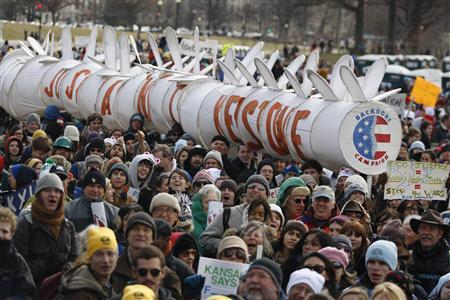
(CLEAN) POWER TO THE PEOPLE, RIGHT ON.
space
EMPOWERING THE GRASSROOTS
In 2005 I made a great little 6 minute video with Mark Dowie, the longtime constructive critic of the environmental movement and author of THE book that every environmentalist should have as required reading, “LOSING GROUND: American Environmentalism as the Close of the Twentieth Century.” The book was nominated for a Pulitzer Prize and is mandatory for all those who live by the quote about not wanting to be condemned to repeat the past.
My video was great, not based on the filmmaking (all I did was set up a camera and let him speak his wisdom, from which I pulled out 6 of the most powerful minutes), but based on the wisdom he conveyed.
space
TOTAL TACTICS
First off, he quoted famed grassroots activist Saul Alinsky (the guy Hillary Clinton did her thesis on which is used by the far right to argue that she’s some sort of demonic socialist) with his term, “TOTAL TACTICS.” That’s the first thing to consider with what Bill McKibben has created with 350.org.
Total Tactics refers to the fact that every mass movement needs action at ALL levels, and more importantly, the various levels need to respect each other and work together. For too long the climate movement has been too top heavy. Matt Nisbet (with his Climate Shift report) and others have pointed out not just the gargantuan sums of money squandered on the failed “Cap and Trade” effort, but also there was an element of blind arrogance in developing the strategy of “let’s pass climate legislation at the top, then explain it to the American public as it gets foisted on them.”
As Theda Skocpol pointed out last month, they failed. Yes, Cap and Trade worked great for acid rain. But it wasn’t as simple as just going for it again with the climate.
It would have been nice if the masterminds of the climate effort had taken a Total Tactics approach of simultaneously creating a coordinated mass movement to accompany the congressional effort. It would have been nice if there had been climate rallies in the spring of 2010 of 35,000 people showing support for the Waxman-Markey bill, but there wasn’t.
Now there is. At last. But of course some people are asking whether this is the proper direction (a writer for Grist painted the rally as “fraying at the ends” which is kinda missing the significance of 35,000 people for climate action for the first time in history). I received a couple of emails from climate friends saying they think the Keystone Pipeline is the wrong target, and Andy Revkin pointed out, “What about what’s happening in oil producing regions like Nigeria?”
space
VISCERAL IS TOUGHER THAN CEREBRAL
I tend to view the world in terms of the cerebral/visceral divide. My take on the rally is that “the message” is the cerebral element. Some might think “the message” of the rally was the Keystone Pipeline, but really the actual message of 35,000 people is much simpler — it’s that 35,000 people care enough about the fate of the climate to turn up.
Who cares about the specific message of a mass rally for now. Just get the bodies out there. Which is what 350.org understands and is doing. THAT is the visceral component — the live action, the experiential. It’s much harder in today’s internet-distracted world (keeping in mind Malcolm Gladwell said, “The revolution will not be tweeted,”) but at the same time, it has more significance and meaning than ever before. And it’s what has been missing.
So I say kudos to McKibben — the guy most likely to provide the LEADERSHIP that the movement has sadly lacked. As Mark Dowie said, you have to have the grassroots element as well as the NGO’s. Both levels are essential and equally important. And they need to respect each other.
The D.C. climate rally is a major step forward in creating a mass movement for climate that will eventually work. Unlike what has transpired so far.
#263) NRDC Demonstrates Effective Storytelling (nicely)
February 11th, 2013
Here’s a textbook example of how to make a nice, simple, friendly, well conceived, developed and executed informative video.
THIS IS HOW TO DO IT: “My Toxic Couch” video from NRDC is very well done
space
“INFORMATIVE MEDIA”
I’m going to call this a piece of “informative media” because I so despise the term “educational media” (almost all of which is so poorly crafted). Let’s take a look at all the ways in which it excels:
STORYTELLING – Last July we (my team of Dorie Barton, Brian Palermo and myself) ran a day-long storytelling workshop at NRDC for which this was one of the storylines presented by Sarah Janssen, an NRDC scientist. Since then, the NRDC folks did an outstanding job of bringing the concept to life. The video presents a story following all the basic rules we discuss. It sets up an “ordinary world” (Sarah, her daughter, her cat on their couch), then takes us into the “special world” of realizing their couch is toxic. She then takes us on a journey of exploration in pursuit of answers to questions she poses (“How can this be possible?” and “Now, it’s in my family’s couch?”). This is exactly how you use storytelling for effective broad communication. And just as a thought exercise, imagine this video without the daughter, cat, and personal story or even artwork — just a bunch of photos of couches with facts and figures. That would be fine for a presentation at a science conference, but not so good with the general public.

FORMAT – In “Don’t Be Such a Scientist” I talked about my belief that this sort of piece (limited imagery presented slowly so that the viewer can absorb the visuals then concentrate on the audio) is more effective for educational purposes than a video where the imagery is constantly moving. This is the divide between entertainment and education. It’s fun to be entertained, but it’s hard to mix entertainment and education. Yes, I know EVERY teacher dreams of it, but the truth is they don’t mix well. If you have a serious issue to communicate, things should be slowed down a bit like this. I came to this conclusion after doing 4 Flash pieces for my Shifting Baselines project, two of which were very popular and effective (“Pristine?” and “Shifting Baselines in the Surf“).
ARTWORK – Brilliant, lovely, friendly, lively, vibrant, human, textured, effective.
VOICE – Perfect, first person with huge credibility, and a voice that is not overly dramatic, affected, strident or monotonic, just simply a bullseye for having the crucial qualities of trust and likeability, all of which is incredibly subjective (welcome to the “art” side of communication)
USE OF TEXT — So good — you need on-screen text for an educational video to hammer home the key points. It’s primarily a visual medium, so you really have to at some point use text to be explicit about your message. Just look at the end of almost any television commercial.
MUSIC SCORING — Really great, the pacing matches the voice and editing
FINAL TOUCH – Love that the cat comes back at the end, solo
“Wow! That was gorgeous, and really effective. I remember clearly how good her story was at the workshop in July, and it’s really thrilling to see how well this turned out. Such a great example to show how effective good story can be, and the message of what we need to do is so clear and simple. The watercolors worked beautifully and brought in a whole new layer of accessibility. Congratulations to all on this terrific piece!” – Dorie Barton
“I totally agree with the above. This is fantastic use of the elements of our workshop. Biggest point: It is RELATABLE! Most of the target audience of voters who could effect change have kids. Many have cats and nearly all have couches. So almost everyone watching this will see themselves in this video. RELATABLE. Which is a perfect way of making dry science personal and important.” – Brian Palermo
#262) A Case of Marine Biological Impotence
February 4th, 2013
That’s the inescapable conclusion when you look at the 50 years of research on the crown-of-thorns starfish problem that has led to no clear answers. This includes my own work in the 1980’s.

HAVING THEIR WAY WITH NATURE AND SCIENCE. The starfish must find it hilarious that after 50 years of research nobody still knows how or why they come and go so dramatically.
space
ONE BIG MYSTERY, ONE BIG MESS
Sorry. I suppose I should put it a little more delicately. But seriously. FIFTY years of research, tens of millions of dollars spent, and we can’t tell you why an extremely common starfish undergoes population explosions? It is a monument to the impotence of the entire field of marine biology. Terrestrial ecologists have no trouble telling you what causes locust or bamboo cycles. But crown-of-thorns starfish? It was a mess when I studied it in the mid-80’s, it’s still a mess.
Not that there aren’t lots of great marine biologists in this world. I’ve known heaps of them. But let’s be honest, this is one of the biggest questions in the entire field of marine biology, and it’s not a particularly complex question (“Why the population explosions?”). And yet … here’s an article just this week saying pretty much nobody knows nuttin’.
space
COULDA FOOLED ME
The article does claim the folks on the Great Barrier Reef have got their story worked out (that the population explosions are caused by nutrient runoff from the land feeding the larvae — if only larval ecology were that simple). I don’t have the time and energy to try and still promote the 4 years of work I did on the problem in the mid-1980’s studying the larvae of the starfish and publishing several peer-reviewed papers. But I will say this — their current thinking (mentioned in this article) is simply wrong. And every so often a marine biologist will track me down with this opinion that they are all wrong and I will agree. But it’s a rats nest, with funding motivation at the core of at least some of the opinions.
Again, sorry, too busy to wade into it. Life is too short. I have movies to make. But this is pathetic that 50 years has produced so little knowledge.
#261) CLIMATE SKEPTICS: Ignore vs. Boycott?
January 28th, 2013
Fine line. Let’s get clear on this. And let’s understand why you need to respect the climate skeptics, whether you hate them or not.
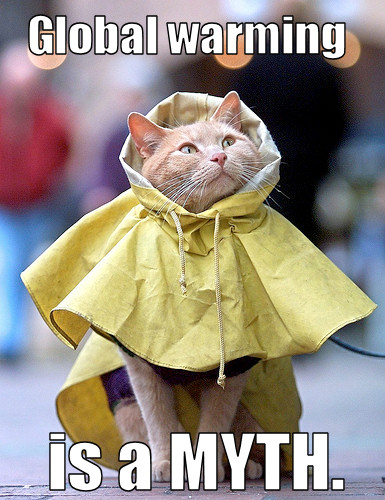
Do climate skeptics deserve your respect? (image from www.trollcats.com)
space
CONTRADICTION? A LOGICAL RESPONSE TO THE MORANO ESSAYS
In response to my Morano and leadership essays last week three people emailed me asking whether I was contradicting myself. On the one hand I’m saying “you can’t afford to ignore climate skeptics,” but on the other hand I’m saying, “When Marc Morano asks for a debate, you should ignore him.” Is this a contradiction? No, but it’s a valid question.
sigh
IGNORE THE MAN, NOT THE MOVEMENT
“Ignoring the climate skeptic movement,” is what Al Gore pretty much did in his movie, “An Inconvenient Truth.” He trivialized the entire climate skeptic movement at a time when the oil companies were starting to pour staggering amounts of money into combatting climate action ($450 million a year by 2008 according to an EDF mass e-mail I received from them in 2009). In the movie he only had one moment involving the climate skeptic movement which was when he talked about Naomi Oreskes’ Science paper surveying over 900 climate science papers. Here is exactly what he said:
“There was a massive study of EVERY scientific article in a peer-reviewed journal written on global warming for the last TEN years, and they took a big sample, of ten percent — 928 articles — and you know the number of those that disagreed with the scientific consensus that we’re causing global warming and that it’s a serious problem … out of the 928 … zero.”
As he says this, on the screen behind him, the number 928 zooms down to 0. That’s a powerful symbolic dismissal of climate skeptics — basically, “Here’s the number of legitimate people you have on your side — ZERO.”
I’m sorry, but I can’t say enough bad things about how tactless of a moment that was. There was no other consideration of what was already a massive opponent to the global warming message. It came at a time where bestselling science fiction author, Michael Crichton, had already reached #1 on the Amazon bestsellers list in 2004 with his (garbage) anti-climate science novel “State of Fear” and the anti-climate action movement had hired far more anti-climate action lobbyists on Capital Hill than the pro-climate action movement had, by a long shot. You don’t represent that amount of effort on the screen with a zero. You just don’t.
It falls under the category of “rising above,” that I discussed in my book — how if you opt to take the path of superiority/arrogance/condescension by looking down on your opponent, saying “you’re trivial,” and simply not engaging, your audience will dislike you and sympathize with your opponent. It’s true and it’s what happened throughout America to some extent as polls showed a shift towards greater climate skepticism.
More importantly, I think it just further fanned the flames of rage among the climate skeptics, eventually erupting in November, 2009 with their hugely successful “Climategate” action, which proved to be a turning point. Previous to Climategate you heard a lot of climate proponents say blindly, “There is no debate about global warming.” After it, nobody said that any more, and if they did they probably heard back, “Are you shitting me?” from whoever was listening since today there is an ENORMOUS debate about it. It may not be a justified debate, but it is definitely a debate, regardless.
So the bottom line is you cannot afford to ignore such a massive movement. Gore should have allocated at least 15 minutes in his movie to present the basic arguments of climate skeptics, saying this is a serious concern, and doing his best to present them in a way in which we can understand what motivates them to fight so much solid science so vigorously. Presenting your opponent in an understandable, dignified, respectable light makes YOU look more confident, more human, and more likeable. And that results in more people being drawn to you. The fact that so many in the climate movement fail to grasp this is a major element in their undoing. And make no mistake, at this point they are definitely undone (see the recent Skocpol article for one statement on this).
space
IRRATIONAL VS RATIONAL VENUES
So, all that said, at the individual level the climate movement HAS to take the skeptics seriously (not ignore them), but should refuse to engage with climate skeptics in IRRATIONAL VENUES, meaning town halls, public “debates”, TV talk show moderated “debates,” or haggling sessions in front of drunken bar patrons (as was staged a couple years ago by a car manufacturer). It’s a losing proposition in such venues. For starters there is no means of controlling “the Gish Gallop,” that I discussed last week.
But on the other hand, if the climate skeptics are ever foolish enough to do what the creationists did in the evolution issue and bungle their way into a RATIONAL VENUE, namely a major court of law, then that is finally the place where all forces should be mustered and they should be taken on 100%. This is what happened with the mighty Intelligent Design movement in December, 2005 at Dover, Pennsylvania, and it was basically their Waterloo.
It was a movement that had a full head of steam, having scored the cover of TIME Magazine in August of 2005. Across the country creationists were winning huge public victories through silly public debates and forums where scientists were having circles spun around them by the fast talking intelligent designers. But then, in a nearly instantaneous event, the entire issue got dragged into a federal court, a very level headed conservative judge gave both sides their chance to make their cases in detail, then rendered a totally rational decision that pulled the rug out from under the movement, and within months the entire monster withered and died.
It’s conceivable that some day that could happen with the climate skeptics, but ONLY if they prove to be as inept as the intelligent designers did. But I don’t think they are that foolish. Which means they’re going to be around for a long time. Which means you’d better respect them, whether it pains you or not.
#260) LACK OF LEADERSHIP: Bane of the Climate Movement
January 25th, 2013
The climate movement suffers from a lack of effective leadership. Here’s an example and an explanation: EXAMPLE: the problem of climate skeptic “debater” Marc Morano run amok (as I discussed yesterday), EXPLANATION: the recent report from Theda Skocpol on the collapse of climate legislation details the absence of effective singular leadership. Who’s in charge of this enormous movement? Who is even the lead voice?

SEEKING CLIMATE BLAME. Theda Skocpol this month released an interesting report in which she seeks to get to the bottom of “Who or what caused the climate movement collapse of 2010?” Was it the economy? Obama? The climate skeptics? The movement itself? She compares the climate movement collapse to the success of Health Care. In my (albeit questionable) opinion I think a lot of it was the arrogance of assuming Cap and Trade worked for acid rain so the fact of that will cause it to “sell itself,” not needing a sustained sales campaign.
fer shure
A STORY OF LEADERSHIP IN THE EVOLUTION WORLD
Let me explain how this leadership stuff works. In the fall of 2006 we did a big screening of “Flock of Dodos” at William and Mary University where my trouble-making former officemate Dr. Mark Patterson managed to line up for the post-screening panel, not just the standard local evolution professor, but also an utter nutball neurophysiologist from Jerry Falwell’s Liberty University who was a Young Earth Creationist.
When the evolutionist heard this, he did what good evolutionists know how to do, which is to seek leadership and guidance from the voice that firmly leads them — Genie Scott at the National Center for Science Education. He called, talked to her, and she simply advised him no, don’t do it — don’t “debate” a creationist in public, it’s a no win situation.
THAT is how leadership works. And it does work for evolution. I know. I’ve made two movies on the two anti-science attacks of evolution and climate. I’ve surveyed the two landscapes. The evolution crowd runs a fairly tight ship, and with Genie’s diligent eye, now keeps a pretty good watch on the countryside.
The climate crowd seems proud of their “individuality” I guess. And they have the further complicating element of large NGO’s claiming they are solving the problems partly through education as they raise donor dollars but in the end they are eco-corporations and no more education-driven than Coke or Pepsi (sorry).
I know NCSE has entered into the field of climate now. If you can’t think of any better approach to the leadership void, just use them the same way as the evolution folks do. Why not? At least they are brave, bold, and willing to take the mantle, unlike the terrified science organizations.
All climate folks, when asked to “debate” Marc Morano, should know how to do what that evolutionist at William and Mary did — call the central source of knowledge, guidance and leadership and seek an opinion. Why can’t that happen? I simply don’t get it. “Oh, we don’t believe in anything centralized.” Good, then fail away.
And I disagree with the climate friends yesterday who, in response to my essay on Morano, dismissed Bill Nye and the Sierra Club dude as a couple of last stragglers who haven’t gotten the memo. There is no memo. There is no single voice of leadership. And the result is disarray as Theda Skocpol pretty much pointed out this month …
fer shure
SKOCPOL’S REPORT: WHO’S IN CHARGE?
For the past three years I was on one national committee for AAAS, now I’m on another for the American Institute of Physics. I get to see this lack of leadership in the science world up close and ask annoying questions about it. Last year I locked horns with Alan Leshner, head of AAAS (and a great guy) in our committee meeting, asking him why there doesn’t exist the leadership to aggressively take on the anti-academic attacks of climate skeptics (like when they are trying to discredit individual scientists or the entire idea of peer review). He replied that the science world is intentionally, “by design” (his exact words) built around committees and thus lacking leadership and not likely to change. He added, “that said, could we use a little bit more leadership at times, certainly.”
The problem is it’s a profession designed for the 1970’s (or really the 1950’s), when the public was so in awe of science that no one would ever dream of attacking an entire profession. But times change. Climate science has been under attack for a decade, and the attackers get to have a field day because there is no effective leadership. It’s that simple.
The problems of the attacks on climate science are reflective of the overall problems of the climate movement in general.
NO fer shure
A MOVEMENT ADRIFT
Skocpol does a great job of highlighting the major milestones that have led to this disarray. Clearly Cap and Trade was the final downfall. In 2007 over 70% of Americans felt we were to blame for climate change, today the number has dropped to below 50%.
Of course, obligatory companion reading to Skocpol’s report is Joe Romm’s critique (he’s always good reading on things like this), where he focuses more on climate skeptics (60%) and irresponsible media (30%) for the blame in his opinion.
There’s so many possible pathways of blame: POLICY – the right sort of policy (the sort that is an easy sell) wasn’t crafted, COMMUNICATION – the campaign was poorly communicated/sold, OPPOSITION – the dirty dawgs of the climate skeptic movement did it, TOP DOWN – the President needed to be the top climate voice but wasn’t up for it.
On and on. I personally like best the basic implications of Daniel Kahneman’s NAS talk last spring which I keep pointing back towards — where he said basically that until the movement creates a voice that is TRUSTED and LIKED, it ain’t gonna be selling squat.
I really hope Naomi Klein is aware of this with her upcoming “Do The Math” campaign that she talked with Bill Moyers about in November. If her campaign this spring comes from the same old UNTRUSTED and UNLIKED voice of elite academics it will be dead on arrival. Sorry, dude.